Which signs match each other?
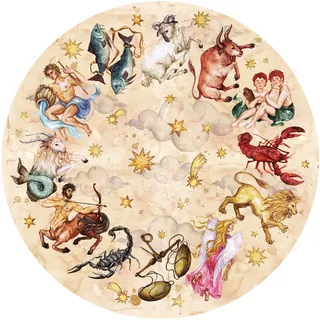
By the classical rule, each sign matches those of its own element and those of the allied element: fire with air, earth with water. It is the table every magazine publishes, and it was not invented yesterday — it comes from the division of the zodiac into four elements and three modalities, which is in elements and modalities.
| Element | Signs | Matches with |
|---|---|---|
| Fire | Aries, Leo, Sagittarius | fire and air |
| Earth | Taurus, Virgo, Capricorn | earth and water |
| Air | Gemini, Libra, Aquarius | air and fire |
| Water | Cancer, Scorpio, Pisces | water and earth |
Notice the size of the list. Each person matches half the zodiac — six signs out of twelve. A rule that approves half the candidates is saying little, and that is where the problem of this page begins.
It is worth knowing where the rule comes from, because it is not arbitrary. Signs of the same element stand 120 degrees from one another, and allied elements 60. They are the trine and the sextile — the two angles the tradition calls harmonious. Signs at 90 and 180 degrees, meanwhile, fall into elements the rule keeps apart. The compatibility table is, at bottom, the table of aspects applied to a single planet.
And that explains the exception everyone talks about: the opposites. Aries and Libra, Taurus and Scorpio, Cancer and Capricorn stand 180 degrees apart, and the rule of the elements fails them — fire against air would be an alliance, but fire against air only happens at 60 degrees, and at 180 what you get is fire against air from the other side of the wheel. In practice the opposite pair is the one most cited in long marriages: each has exactly what the other lacks. The tradition always knew this, and calls the opposition tense, not bad.
Does the compatibility table work?
It gets one thing right and one wrong, and the two are worth separating. It is right that fire and air understand each other by temperament — both are quick, both like movement and ideas. It is right that earth and water do too — both are slow, and both measure before acting.
It is wrong in turning that into a prediction about the relationship. And it is possible to show why, with a number.
I drew 400 thousand pairs of birth dates between 1966 and 2025 and asked the following: when the two Suns match by the rule of the elements, do the other pieces of the chart match too? If the rule carried information about the meeting, they ought to follow.
| Among pairs with “compatible” Suns | Measured | Pure chance |
|---|---|---|
| The Moons match too | 50.0% | 50% |
| The Venuses match too | 51.3% | 50% |
Fifty per cent is exactly what tossing a coin would give. Knowing that your Suns match says nothing about the other's Moon — and the Moon is the piece that most decides how two people live together day to day, because it is the way of feeling, of needing and of calming down.
That does not make the table false. It makes it small: it describes one trait of temperament, measured at a single point of the chart, out of the ten that exist. Using it to decide who to date is reading a book by the first letter of its title.
Why does Venus never stray far from my solar sign?
Because Venus is chained to the Sun: she never moves more than 47.2 degrees away from it. Measured across the 21,915 days between 1966 and 2025, with the same ephemeris that builds charts on this site. With Mercury the chain is shorter still — 27.8 degrees.
The consequence is a pretty one and almost nobody mentions it:
| Given your solar sign | Venus | Mercury |
|---|---|---|
| Possible signs | 5 | 3 |
| In the same sign as the Sun | 23.7% | 51.0% |
| Maximum separation | 47.2° | 27.8° |
In other words: your solar sign does carry a little information about your taste — because Venus, who is taste, can only be in five signs neighbouring your Sun. It is that chain that makes the compatibility table seem to work sometimes. It works neither by magic nor by mistake: it works a little, by geometry.
And it is also why it stops working quickly. Five neighbouring signs span more than one element, and in the calculation above the Venus agreement came to 51.3% — the chain exists, but it does not survive as far as the element. Someone born in Taurus can have Venus in Pisces, Aries, Taurus, Gemini or Cancer: two of earth and water, two of fire and air, and one in the middle.
Your Venus is in one of five signs, and only the calculated chart says which. It is the difference between “I am a Taurus” and knowing what you actually find beautiful.
Generate my chart for freeDo two identical signs match?
By the rule, yes — and in practice it is the most uneven combination there is. Two people of the same sign recognise each other in twenty minutes of conversation, and that initial ease is real. What comes after is what varies a great deal.
The reason is simple to state: two people of the same sign have the same blind spot. Two Capricorns will not remind each other to rest. Two Pisces will not chase the deadline. The relationship runs well as long as the subject is what both do well, and seizes up entirely on the subject neither of them looks at.
That is why the useful question is not “do we match?”, but “are our blind spots the same?”. Two identical Suns and two different Moons is a relationship with cover; two identical Suns and two identical Moons is a very comfortable house with a door nobody opens.
The same holds for the opposite pair, in reverse: two blind spots that do not coincide make for hard work at the start and cover at the end. That is why initial ease is a terrible sign of durability — it measures likeness, not fit.
Which sign is most compatible with mine?
There is none, and the better answer is what you look for instead. A relationship does not hold together by likeness of sign: it holds together by fit between different pieces, and the fit is read by crossing both charts in full.
What a reading of two people looks for, in order:
- One person's Moon with the other's Sun. It is the contact that describes mutual care — who needs what, and whether the other has that to give.
- One person's Venus with the other's Mars. Desire, and the way of going after it. It holds in both directions, and the two directions are usually different.
- Which house each one lands in, in the other's chart. The same Venus in your house 5 and in your house 12 is passion in one case and a private matter in the other.
- The Ascendants. They say what each one saw first in the other — and why the first impression was that one.
None of this comes out of a table, and that is the difference that names the method: synastry is the crossing of two charts, and it demands date, time and city of both. Comparing solar signs is what is left when you do not have that.
What sign compatibility does not say about the two of you
It does not say whether the relationship will work out, and whoever promises that is selling something else. Ten pieces make a chart, and the compatibility table reads one.
Four things it leaves out that change everything:
- Each person's Moon. Two Aries people with Moon in Cancer and Moon in Aquarius do not need the other in the same way, and that is where living together happens.
- The Ascendant. It changes every two hours and depends on the city. Two Virgos born on the same day can arrive at a party in opposite ways.
- The house each one lands in. No sign table has that layer, because it demands the hour of both.
- What each one has already lived. Age, earlier histories and the moment of meeting weigh more than any aspect — and they are in nobody's chart.
And the limit said out loud holds: astrology decides for nobody, does not tell you to stay or to leave, and replaces neither conversation nor therapy. It gives vocabulary. A couple who find out that one Moon needs routine and the other needs novelty have gained a better question than the one they had — they have not gained a verdict.
Frequently asked questions about sign compatibility
Which signs match each other?
By the rule of the elements, each sign matches those of its own element and those of the allied element: fire with air, earth with water. That puts half the zodiac on everyone's list — which already shows the size of the information. The rule describes similar temperament, not a relationship that works.
Does the sign compatibility table work?
It gets one thing right and one wrong. It is right that fire and air understand each other by temperament, and that earth and water do too. It is wrong in treating that as a prediction about the relationship: I measured 400 thousand pairs of dates and, when the two Suns match by the rule, the Moons match in 50.0% of cases — exactly what tossing a coin would give.
Why is Venus never far from my solar sign?
Because Venus never moves more than 47.2 degrees away from the Sun, measured between 1966 and 2025. Given your solar sign, your Venus can only be in five signs, and in 23.7% of cases she is in the same sign as the Sun. With Mercury the chain is shorter still: 27.8 degrees, three possible signs, and a 51% chance of being the same one.
Do two identical signs match?
By the rule of the elements, yes, because the element is the same. In practice it is the most uneven combination there is: two people of the same sign recognise each other quickly and repeat the same blind spot. What decides is not the repeated sign — it is whether each one's Moon and Venus point in different directions.
Which sign is most compatible with mine?
There is none, and the question has a better answer than it seems: what you look for in a relationship is not likeness of sign, it is fit between different pieces. One person's Moon with the other's Sun, one person's Venus with the other's Mars, and the house each one lands in within the other's chart. That is synastry, and it demands date, time and city of both.
Sign compatibility in short
Keywords elements, temperament, the chain of Venus, repeated blind spot
The numbers on this page hold for any pair of people, because they come from the sky. What does not hold without calculation is your own case. Your Venus is in one of five signs and your Moon changes every two and a half days; your Ascendant changes every two hours and depends on the city. Without date, time and city, this page describes a rule — not the two of you.
