What elements and modalities are
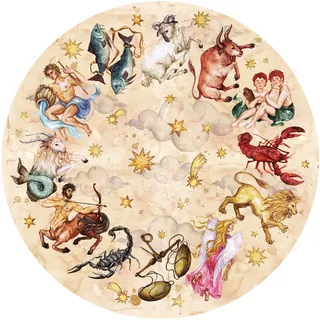
They are two ways of grouping the twelve signs, and both come from the order of the signs in the zodiac — not from a table someone memorised. The element is every fourth sign; the modality, every third.
Start at Aries and count: Aries is fire, Taurus is earth, Gemini is air, Cancer is water, and Leo returns to fire. Every four, always. The modality is the same idea with a different step: Aries is cardinal, Taurus is fixed, Gemini is mutable, Cancer returns to cardinal. Every three.
That is why the two never repeat together: four and three share no divisor, and the twelve combinations give exactly the twelve signs. Each sign is a unique pair of element and modality, and none repeats.
| Cardinal | Fixed | Mutable | |
|---|---|---|---|
| Fire | Aries | Leo | Sagittarius |
| Earth | Capricorn | Taurus | Virgo |
| Air | Libra | Aquarius | Gemini |
| Water | Cancer | Scorpio | Pisces |
The element says what the response is made of — fire acts, earth builds, air names, water feels. The modality says at what moment it enters — cardinal begins, fixed holds, mutable adjusts. A sign is always both at once, and it is the combination that describes it: Taurus is not “earth”, it is earth that holds; Virgo is earth that adjusts.
What your screen shows, and with how many points
Your chart’s grid counts eleven points: the ten planets and the Ascendant. Sun, Moon, Mercury, Venus, Mars, Jupiter, Saturn, Uranus, Neptune, Pluto and the degree that was rising on the horizon when you were born.
Without a birth time there are ten, not eleven — the Ascendant is the only one that depends on the clock, and without it the grid is born one point short. That is not a hole or an error: it is the honest count with what is known.
Houses, nodes, Chiron and the other points do not enter. That is a choice, and it is worth knowing: a site counting fifteen points would give other numbers, and comparing your grid with another one without checking how many points each counts is comparing different things.
How many points each element usually has
Eleven points shared among four elements would give 2.75 each if the sky were flat. We measured it in 124,185 charts, every six hours between 1940 and 2025, and each element’s average lands on top of that: fire 2.75, earth 2.82, air 2.74, water 2.69.
Except that the average is not what you see. What you look at on the screen is the fullest element, and it almost never has 2.75 points:
| The fullest element has | In how many charts |
|---|---|
| 3 of the 11 points | 8.5% |
| 4 of 11 | 45.1% |
| 5 of 11 | 32.0% |
| 6 of 11 | 11.3% |
| 7 of 11 | 2.6% |
| 8 of 11 | 0.4% |
Four or five points in one element is the case for three people in four. If your chart has five in water, that is not a standout: it is the norm. What draws attention starts at six, and six happens in one chart in nine.
Missing an element is common, and missing a modality is not
In 17.3% of charts at least one element is left empty. One in six. And in 0.2% two are missing, which then really is uncommon.
With modalities the count is different: only 2.0% of charts have one empty. The difference has an arithmetic cause and not an astrological one — there are three modalities for eleven points, and four elements for the same eleven. With fewer drawers, it is harder to leave one empty.
It is worth saying what “missing” means here, because the lazy reading gets it wrong: it does not mean you lack that quality. It means none of the eleven measured points fell into that group — and the same person may have a whole house of that element, an Ascendant pulling her that way, or a planet leaning on a cusp.
And here is what almost no text says: part of your grid belongs to your decade
The split by element swings with the year of birth, and it swings a lot. Decade by decade, in the same 124,185 charts:
| Born in the decade | Fire | Earth | Air | Water |
|---|---|---|---|---|
| 1940 | 3.00 | 2.59 | 3.38 | 2.03 |
| 1960 | 2.23 | 3.66 | 2.12 | 2.99 |
| 1980 | 3.05 | 2.65 | 2.50 | 2.80 |
| 2000 | 2.80 | 2.20 | 3.41 | 2.60 |
| 2020 | 1.71 | 3.85 | 2.57 | 2.88 |
Someone born in the 2020s has, on average, 3.85 points in earth and 1.71 in fire. Someone born in the 1940s had 3.38 in air and 2.03 in water. It is not the same chart with another person inside: it is another distribution.
And the cause is measurable. We redid the same measurement with pieces of the chart, to see which of them the swing comes from. The range below is the distance between the decade where an element shows up most and the one where it shows up least:
| Counting | Points | Swing between decades |
|---|---|---|
| the whole eleven points | 11 | 1.65 |
| Sun, Moon, Mercury, Venus, Mars and the Ascendant | 6 | 0.15 |
| Jupiter and Saturn | 2 | 0.38 |
| Uranus, Neptune and Pluto | 3 | 1.66 |
Three points out of eleven produce the entire swing, and the six personal ones barely move. The reason is easy to see: Pluto takes twelve to thirty years in each sign, Neptune takes fourteen, Uranus takes seven. People born in the same stretch of years have all three in the same place — and three of the eleven points is already more than a quarter of the grid.
So if your chart has five in earth, the first useful question is: how many of those five are Uranus, Neptune or Pluto? If three of them are, what the grid is counting is your generation, not you.
Your chart’s grid of elements by modality comes ready in the free chart, with the eleven points listed one by one — you can see at a glance which are personal and which belong to your decade.
See my grid, freeThe part that is yours: the six personal points
If the three slow ones belong to the decade, the good question remains: how does the split look when you count only what is yours? Sun, Moon, Mercury, Venus, Mars and the Ascendant — six points. Measured in the same charts, they come out practically flat: 1.50 in fire, 1.49 in earth, 1.51 in air and 1.49 in water.
And here the missing count reverses, which is the most useful finding on this page:
| In the 11 points on screen | In the 6 personal ones | |
|---|---|---|
| At least one element missing | 17.3% | 68.2% |
| At least one modality missing | 2.0% | 19.9% |
“I have nothing in fire” is uncommon in what the screen shows and common in what is yours: it goes from one chart in six to two in every three. The explanation is the same as before, seen from the other side — the three slow planets fill holes that are not yours. A person with no personal point in fire may have Pluto in Sagittarius and see the screen say “you have fire”.
It is not that one of the two counts is wrong. They are different questions: the eleven-point one describes the whole chart; the six-point one describes what your date and your hour chose.
What the grid does not say
It does not say who has more of anything. Five in water is not more sensitive than four; three in fire is not less brave than five. The grid is a count, and a count is not a measure of intensity — a lone Sun in Aries weighs more in a person’s life than Neptune, Pluto and Uranus together in Sagittarius.
And it does not say what to do. The usual reading tells you to “compensate for the missing element”, and that instruction does not come from the count: it comes from custom. What the measurement shows is more modest and more useful — missing is common, and what changes from person to person is which point sits where, not the total.
A limit said out loud, because it is part of reading seriously: none of this is prediction. Astrology describes tendency and gives vocabulary for what a person already lives — it does not replace work or a decision of yours.
To see where each point of your grid comes from, start with the series The Sun in the 12 signs and The Moon in the 12 signs. And to understand why the three slow ones belong to a cohort and not to a person, see Pluto in the 12 signs, which explains the size of each generation.
Frequently asked questions about elements and modalities
I have no planet in fire. Is that bad?
No, and it is more common than it looks. Counting the eleven points on screen, 17.3% of charts have an element left empty — one in six. Counting only the six personal points, it rises to 68.2%: two in every three. Missing is the normal case, not the exception.
How many points go into that count?
Eleven: the ten planets and the Ascendant. Without a birth time there are ten, because the Ascendant is the only one that depends on the clock. Houses, nodes and Chiron do not enter — and that is why your grid here may not match another site’s, which perhaps counts other points.
Is five points in one element a lot?
It is common: it happens in 32.0% of charts, and four points happens in 45.1%. Added up, three people in four have four or five in the fullest element. What starts to be a standout is six, which shows up in 11.3% — one chart in nine.
Why do so many people my age have the same element loaded?
Because three of the eleven points belong to a generation. Uranus stays seven years in each sign, Neptune fourteen and Pluto twelve to thirty — people born in the same stretch of years have all three in the same place. Measured: the grid’s swing between decades is 1.65 points, and on their own those three account for 1.66. The six personal points swing 0.15.
What is the difference between element and modality?
The element says what the response is made of fire acts, earth builds, air names, water feels. The modality says at what moment it enters — cardinal begins, fixed holds, mutable adjusts. Every sign is both at once, and the twelve combinations give exactly the twelve signs, with none repeated.
A whole modality is missing from my chart. Is that the same as a missing element?
It is far less common: 2.0% of charts, against 17.3% for elements. And the reason is arithmetic, not astrological — there are three modalities for eleven points and four elements for the same eleven. With fewer drawers, it is harder to leave one empty.
Elements and modalities in brief
Keywords elements, modalities, fire, earth, air, water, cardinal, fixed, mutable
The Sun and Mercury can only be in conjunction. Mercury never gets 27.8 degrees away from the Sun, so a square between the two does not exist — and a site that shows one got the calculation wrong. See your chart free here.
See your whole chart, for free
Sun, Moon, Ascendant, the planets, the houses and the aspects calculated from your date, time and city of birth. It takes less than a minute.
Generate my birth chart for freeQuestions for people just starting out
The Sun in the 12 houses
The sign says how; the house says where. It is the piece that depends most on the exact time of birth.
Mercury in the 12 signs
Your Mercury is in your Sun's sign, the one before or the one after — and it is what explains why two people of the same sign think so differently.
Venus in the 12 signs
Your Venus is in your Sun's sign, in the two before it or the two after it — and it is what explains why two people of the same sign love so differently.