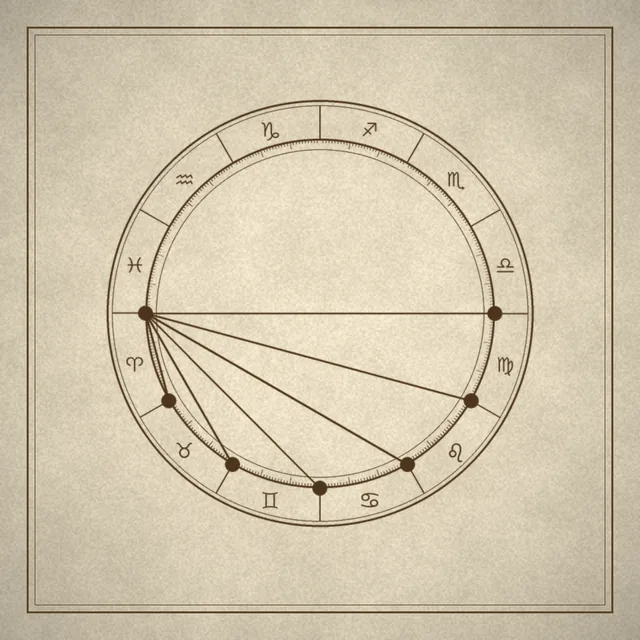
An aspect is a distance between two planets, measured in degrees on the wheel of the zodiac. It is not a force, not an event and not an influence: it is an angle measurement, and astrology assigns meaning to some of those measurements.
Five of them are the main ones, and they divide the circle into whole parts: the conjunction (0°) is dividing by one, the opposition (180°) by two, the trine (120°) by three, the square (90°) by four and the sextile (60°) by six. There is no mystery in the choice, they are the simple divisions of the circle, which is why they turn up in nearly every school.
The traditional reading takes the conjunction as fusion, the opposition as tension between two sides, the square as friction that demands action, and the trine and sextile as ease. That is useful vocabulary. What almost no text mentions is what comes next.
Sweeping a hundred years of sky, a chart has 12.4 aspects on average among the ten bodies. The median is 12, and the range runs from 2 to 35.
That already answers a common question, and answers it in a disappointing way: having many aspects is neither uncommon nor special. It is the norm. A chart with fifteen aspects and one with ten are the same kind of chart.
Two planets are almost never at exactly 90 degrees. So each school defines a tolerance, the orb, and within it the aspect counts. This site uses larger orbs for the Sun and the Moon and smaller ones for the distant planets, which is the commonest convention.
Changing that tolerance doubles or halves the number of aspects in your chart. Measured on the same sky, changing only the orb:
With half this site's orb, there are 6.3 aspects per chart; with this site's orb, 12.4; and with double it, 24.9.
It is not that one is right and the other wrong. It is that the question “do I have that square?” has no answer until somebody says which orb they are using, and that is why an honest reading reports the orb along with the aspect, as this one does.
The five do not turn up in the same proportion, and the difference is geometric, not symbolic:
Of the aspects formed, the conjunction (0°) takes 19.9%; the sextile (60°), 23.0%; the square (90°), 23.3%; the trine (120°), 21.7%; and the opposition (180°), 12.1%.
The opposition is the least common of the five, at 12.1%. The reason is simple: 180 degrees is a single place on the wheel, while 60, 90 and 120 are two each, one on either side. The conjunction is also a single place, but it wins back ground because the conjunction orbs are the largest of all.
Your chart comes with the aspects calculated, the orb of each one and the exact distance.
See my aspectsMercury and Venus cannot get away from the Sun, so there are aspects they never form. That is not a school's opinion: it is the orbit. Measuring each pair's separation across a hundred years:
The Sun and Mercury range from 0.0° to 27.8° apart, and form only the conjunction; the Sun and Venus, from 0.0° to 47.2°, conjunction only; Mercury and Venus, from 0.0° to 73.8°, conjunction and sextile; Uranus and Neptune, from 0.0° to 145.9°, all but the opposition; Uranus and Pluto, from 0.0° to 130.4°, all but the opposition; and Neptune and Pluto, from 42.6° to 65.3°, sextile only.
The Sun and Mercury can only be in conjunction. If a site showed you “Sun square Mercury” or “Sun opposition Mercury”, it did not calculate the sky, Mercury never got 90 degrees from the Sun in a hundred years, and it is not going to.
The same goes for the Sun and Venus. And at the other end of the list is the most curious case: Neptune and Pluto spent the whole century between 42.6 and 65.3 degrees of each other, so the only aspect they form is the sextile.
Neptune takes fourteen years to change sign and Pluto takes up to thirty. When two planets move that slowly, the aspect between them stands for decades, and everyone born in that stretch has the same one.
Neptune sextile Pluto holds for 49.4% of the century, but in blocks:
Of those born in the 1930s, 0.0% have Neptune sextile Pluto; in the 1940s, 41.9%; in the 1950s, 98.7%; in the 1960s, 66.9%; in the 1970s, 84.6%; in the 1980s, 92.2%; in the 1990s, 25.1%; in the 2000s, 0.0%; in the 2010s, 6.9%; and in the 2020s, 77.7%.
Anyone born in the 1950s has that aspect in 98.7% of cases; anyone born in the 2000s, in 0.0%. It is the same aspect, and it describes the generation, not the person. A reading that presents an aspect between slow planets as an individual trait is describing a birth-cohort characteristic.
For aspects among the Sun, Moon, Mercury, Venus and Mars that does not happen: they move fast, and the aspect changes from one day to the next. Those are the ones that say something about somebody in particular.
An aspect is neither good nor bad. The split between “tense” and “harmonious” aspects is a teaching device and a coarse one: a trine describes something that runs easily, and running easily is not always what serves. The useful reading asks what the person does with it.
And a tight aspect is not a strong aspect. A smaller orb means the two are closer to the exact angle, it is a measure of proximity, not of intensity in anyone's life. No experiment has shown that half a degree of orb produces more effect than five.
A limit said out loud, because it is part of reading seriously: none of this is prediction. Astrology describes tendency and gives vocabulary for what a person already lives, it does not determine what will happen, and nobody should be selling that.
And the questions that come up most on this subject, with the short answer:
How many aspects is it normal to have? Among the ten bodies, the average is 12.4 and the median is 12, the measured range runs from 2 to 35. Having many is not uncommon, and having few does not mean anything special either.
What is an orb? It is the tolerance in degrees that a school accepts around the exact angle. It is not a fact about the sky, it is a convention, and doubling the orb takes a chart from 12.4 to 24.9 aspects, while halving it takes it down to 6.3.
Is a tight aspect stronger? It is closer to the exact angle, and that is all the measurement says. The idea that a small orb produces a large effect is an interpretation, not a result, there is no experiment that confirms it.
Can I have the Sun square Mercury? Nobody can. Mercury never gets more than 27.8 degrees from the Sun, and a square needs 90. If a site showed you that, it got the calculation wrong.
Why does my chart have so many aspects with Neptune and Pluto? Because they move slowly and stay in the same place for years. Aspects between slow planets are shared by whole generations: Neptune sextile Pluto, for instance, turns up in 98.7% of those born in the 1950s and in 0.0% of those born in the 2000s.
Which aspect is the least common? Of the five major ones, the opposition, at 12.1% of the aspects formed. And the reason is geometric: 180 degrees is a single point on the wheel, while 60, 90 and 120 are two each.
In short:
Keywords aspects, orb, conjunction, square, trine, sextile, opposition
The Sun and Mercury can only be in conjunction. Mercury never gets 27.8 degrees away from the Sun, so a square between the two does not exist, and a site that shows one got the calculation wrong. See your chart free here.
Questions for people just starting out
The Sun in the 12 houses
The sign says how; the house says where. It is the piece that depends most on the exact time of birth.
Mercury in the 12 signs
Your Mercury is in your Sun's sign, the one before or the one after, and it is what explains why two people of the same sign think so differently.
Venus in the 12 signs
Your Venus is in your Sun's sign, in the two before it or the two after it, and it is what explains why two people of the same sign love so differently.