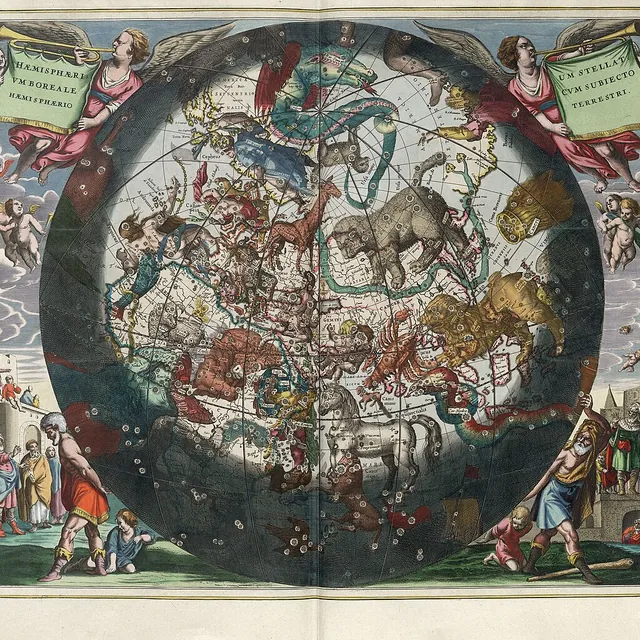
Fixed stars are the stars that astrology reads as points of the zodiac, and a star only weighs in the chart when it touches a planet or an angle closely; since almost every chart touches several, what matters is which star, which point and what kind of contact. We measured some of these things with the engine that builds the charts on this site, and the numbers are in the text.
They are called fixed because, next to the planets, they seem not to move: they form the same figures since anyone has looked at them. The tropical zodiac, however, measured from the equinox, slides in relation to them through precession, about one degree every 72 years. Ptolemy, in the second century, catalogued nearly a thousand stars in the Almagest and gave them the nature of planets in the Tetrabiblos. Since the year 137 the stars have moved, by our count, 26.3 degrees: Regulus, the Heart of the Lion, was at 3°55' Leo and is today at 0°12' Virgo, where it entered in 2012.
The relationship between stars and practical life is older than the astrology of the signs. In Egypt, the heliacal rising of Sirius, the first morning of the year on which it reappears on the horizon before the Sun, fell around July and coincided with the flooding of the Nile, and for that reason the star, called Sothis, marked the start of the year. It is the heliacal phenomenon that the engine also calculates, and it is a good reminder that the star was first a calendar and only later a symbol.
On 4 November 2026, the main ones are at these degrees, calculated with the catalogue and the precession of the site's engine: Algol, at 26°33' Taurus; the Pleiades (Alcyone), at 0°22' Gemini; Aldebaran, at 10°10' Gemini; Sirius, at 14°27' Cancer; Regulus, at 0°12' Virgo; Spica, at 24°13' Libra; Antares, at 10°08' Sagittarius; and Fomalhaut, at 4°14' Pisces.
Four of them the Persian tradition calls royal stars, the guardians of the four corners of the sky: Aldebaran in the east, Regulus in the north, Antares in the west and Fomalhaut in the south. Today they form almost a cross. Aldebaran and Antares are 180° from each other, with a difference of two arcminutes, and Regulus and Fomalhaut are at 184°.
In medieval and Renaissance magic, fifteen stars gained a fame of their own. Agrippa, in the Occult Philosophy, arranges them with a stone, a plant and a sigil for each, and among them are Algol, the Pleiades, Aldebaran, Capella, Sirius, Procyon, Regulus, Spica, Arcturus, Antares and Vega. It is the point at which the fixed stars meet the talisman, and whoever wants to follow that conversation can read Astrological talisman.
Each star brings a story, and the modern reading works with them as symbols. Algol is the head of Medusa, in the constellation of Perseus, and its name comes from the Arabic ra's al-ghul, “the head of the spectre”; the tradition treats it as one of the most difficult in the sky. We can read it as the image of what paralyses when looked at head-on, and Perseus, who defeats Medusa by looking at the reflection in the polished shield, as the lesson of looking sideways at what is too much to be looked at directly. Regulus, the little king, is associated with honour and prestige, with the old warning that brilliance demands conduct. Spica, the ear of grain of Virgo, is linked to gifts and talent.
A number puts everything in proportion. The catalogue the engine uses has 50 stars and clusters, and with an orb of 1 degree (1.5 for the 15 main ones) they cover 27.5% of the zodiac. A chart has 14 usual targets, the ten planets and the four angles, so, on average, each chart touches close to four stars, and the chance of touching none is about 1%, under the simplified hypothesis that the targets fall independently. Anyone who hears “you have a star conjunct your Sun” is hearing something that happens to about one person in four for that point, and to almost everyone for the chart as a whole.
For that reason the serious reading separates four techniques. Conjunction by longitude projects the star onto the zodiac and is the one the tradition reads. Real proximity measures the distance in the sky, which can be much greater when the star is far from the ecliptic. The parans compare star and planet when each is on one of the four angles, at the same instant. And heliacal phenomena mark the day the star appears or vanishes near the Sun. Putting everything into one sentence (“you have Regulus”) hides which of the four is being read.
What human question lives here? Perhaps the one about scale. Pascal wrote in the Pensées: “The eternal silence of these infinite spaces terrifies me.” Looking at stars light years away and reading in them something about our life is a gesture of scale, and we can ask what it does to us: does it console us, show us small, give us back a language for speaking of what has no name? The star stays where it is; what the reading changes, if it changes anything, is the attention of whoever looks.
To read the stars in your chart, the order that helps is this. First the contacts with the Sun, the Moon, the Ascendant and the Midheaven, which weigh most. Then the main stars. Then the orb, the smaller the better. Birth time matters, because the angles and the parans depend on it; without a time we can still read the planets, with the limitations stated.
A fixed star is a symbol, and the tradition that gives it the nature of a planet and a destiny of honour or fall is an interpretive tradition. No study shows that having Algol or Regulus next to a point defines a life. The useful reading is the one that uses the star as an image for a question, and leaves it open.
Fixed stars birth chart · R$ 197,00
The fixed stars that touch your natal chart, with the myth and tradition of each one and the parans and heliacal phenomena of your birth.
If you would like to see which stars touch your birth sky, the Fixed stars birth chart reads the stars that touch your chart, the myth and tradition of each one, and the parans and heliacal phenomena of your birth. To see the tradition in which that reading was born, the Medieval astrological chart reads your chart as in the Middle Ages.
The question that remains is: what story was the sky telling at the hour you were born, and what would you do with it?
Some questions that tend to come up about the fixed stars:
What are fixed stars in astrology? They are stars that astrology reads as points of the zodiac. A star weighs in the chart when it touches a planet or an angle closely, and the tradition gives each one a nature, generally described by planets, and a story of myth.
Why are they called fixed if they move? They are called fixed because, compared with the planets, they seem motionless. What changes is the tropical zodiac, which slides in relation to them by about one degree every 72 years, through precession. Since Ptolemy, the stars have moved more than 26 degrees.
Which are the four royal stars? They are Aldebaran, Regulus, Antares and Fomalhaut, called in the Persian tradition the guardians of the four corners of the sky. In 2026 they are at 10°10' Gemini, 0°12' Virgo, 10°08' Sagittarius and 4°14' Pisces.
Is Algol a dangerous star? The tradition treats it as difficult, because it represents the head of Medusa. Today it is preferred to read it as a symbol of what paralyses when looked at head-on. No star determines an event, and each reading depends on the rest of the chart.
Do I need my birth time to read the fixed stars? It helps a lot. The angles and the parans depend on the time. Without it, we can still see the contacts of the planets with the stars, with the limitation that the Ascendant and the Midheaven are left out.
In short, the fixed stars are points of the zodiac that astrology reads as symbols, and they have changed place: since Ptolemy they have moved 26.3 degrees, and in 2026 Regulus is at 0°12' Virgo. Since the catalogue covers 27.5% of the zodiac, almost every chart touches several, and what gives the reading meaning is the main star, the point it touches, the technique used and the orb.
Keywords fixed stars, Regulus, Algol, royal stars, precession, parans, Ptolemy
If what you want is this read in your chart, with the myth and tradition of each star, that is what you get from the reading Fixed stars birth chart. See the reading