When is the next eclipse?
The calculation uses the same ephemeris that builds this site's birth charts, and the answer comes from your device's clock.
Eclipse
How the next eclipse season will affect you, and how to prepare to live through this period.
R$ 29,90Ready within 1 day I want to know how it affects me ♅12 Houses Chart
A practical guide, house by house: what to do and what to avoid in love, money, work, family and the other areas.
R$ 197,00Ready within 1 day I want to unlock the 12 areas of my life Start here☉Personality and essence
Who you really are according to your chart: your way of being, your strengths and what drives you.
R$ 79,90Ready within 1 day I want to understand my personalityThe next one is on {quando}: a {tipo} in {signo}.
The last one was on {quando}, a {tipo} in {signo}, the seasons repeat every 173 days.
The calculation on this page runs to 2035, and your date is beyond it.
total solar eclipse annular solar eclipse partial solar eclipse total lunar eclipse partial lunar eclipse penumbral lunar eclipse Aries Taurus Gemini Cancer Leo Virgo Libra Scorpio Sagittarius Capricorn Aquarius PiscesEclipses happen in seasons, and there are two a year. Each season brings two or three eclipses in about a month, and then the sky goes five months with none. The times below are Brasília time and come from the same ephemeris this site uses to build charts.
On February 17, 2026, an annular solar eclipse in Aquarius; on March 3, 2026, a total lunar eclipse in Virgo; on August 12, 2026, a total solar eclipse in Leo; on August 28, 2026, a partial lunar eclipse in Pisces; on February 6, 2027, an annular solar eclipse in Aquarius; on February 20, 2027, a penumbral lunar eclipse in Virgo; on July 18, 2027, a penumbral lunar eclipse in Capricorn; on August 2, 2027, a total solar eclipse in Leo; on August 17, 2027, a penumbral lunar eclipse in Aquarius; on January 12, 2028, a partial lunar eclipse in Cancer; on January 26, 2028, an annular solar eclipse in Aquarius; on July 6, 2028, a partial lunar eclipse in Capricorn; and on July 21, 2028, a total solar eclipse in Cancer.
Look at the sign of each one. In 2026 and 2027 the eclipses fall in Aquarius and Leo, in Virgo and Pisces; by 2028 it is Cancer and Capricorn. That is not chance, and what follows explains what decides it, it is the same thing that decides WHY they come round every six months.
A New Moon happens every month, and so does a Full Moon. If that were enough, there would be twelve eclipses a year of each kind. What is missing is height.
The Moon's orbit is tilted by about five degrees against the Sun's path. At most New Moons the Moon passes above or below the Sun as seen from the Earth, and its shadow touches nothing. There is an eclipse only when the lunation happens near one of the two points where the two orbits cross, the lunar nodes, the same ones from South Node in the chart.
Measured across the 433 eclipses between 1930 and 2025: the Moon was never more than 1.55 degrees of height away at a solar eclipse, nor more than 1.57 at a lunar one. Its limit is a little over five degrees, which means every eclipse happens inside a narrow band around the nodes, and that is why they cluster into seasons.
The Earth passes through that region twice a year, and the gap between one season and the next is 173.4 days, measured across the 202 seasons of those 96 years, with the shortest at 162.5 and the longest at 184.3. Two seasons add up to 347 days, and the year has 365: that is why the dates move about nineteen days backwards each year, and it is why eclipses stay in the same pair of signs for years before moving on.
There were 433 eclipses between 1930 and 2025, an average of 4.51 a year. Sixty-two of those 96 years had exactly four; twenty-two had five; nine had six; and only three years reached seven.
That changes what the word can explain. Something that happens four or five times a year is not the explanation for a hard year, and anyone saying “the eclipse shook everything up” is talking about something that happens every eleven weeks on average.
What almost never happens is something else: a TOTAL solar eclipse passing exactly over your own city. The band in which totality is visible is a few hundred kilometres wide, and it almost always falls over the sea or over land with nobody on it. There were 69 total solar eclipses in 96 years across the whole planet, how many of them passed over your own back yard is another number, and a far smaller one.
There are six types of eclipse, three on each side, and the difference is geometry, not symbolic intensity. The count below comes from the same 433:
- Total solar (69 in 96 years). The Moon covers the Sun's disc completely. It is the only one in which the sky goes dark in daytime, and only inside the narrow band of the shadow.
- Annular solar (67). The Moon is farther from the Earth and does not cover everything: a ring of Sun is left around it. Same geometry, different distance.
- Partial solar (78). The shadow grazes past and the Moon bites a piece out of the Sun. It is the most common of the three.
- Total lunar (82). The Moon goes fully into the Earth's shadow and turns reddish. Totality lasted between 13 and 107 minutes across the 90 times it happened between 1930 and 2035, averaging 71 minutes.
- Partial lunar (59). Only part of the Moon goes into the shadow, you can see the dark curve biting into the disc.
- Penumbral lunar (78). The Moon passes through the edge of the shadow and only dims a shade. Plenty of people look and see no difference at all, and it counts anyway.
In astrology, what usually weighs is not the kind: it is where it falls. A penumbral on the degree of your Sun says more about your year than a total one on the far side of your chart.
Predicting eclipses is one of the oldest things astronomy knows how to do, and it began as astrology. The astronomers of Babylon worked out, before the sixth century BC, that eclipses repeat every 6,585 days and a third, 18 years, 11 days and 8 hours. It is the cycle now called the Saros, and Ptolemy already records it in the Almagest.
The third of a day is the interesting part: since it does not close a whole number of days, the next eclipse of the same family happens with the Earth turned a third of the way round, that is, over another part of the planet. It takes three Saros cycles, 54 years, for an eclipse to come back to roughly the same region.
In the tradition, the eclipse was always read as a mark of time: not the cause of what happens, but the stamp on a period. It is a soberer reading than the internet's, and it is the one this site uses.
The sky is the same for eight billion people, and the chart is not. The eclipse happens at a degree, 28 degrees of Aquarius, say. What it means for you is what you have at that degree: a house, a planet, a point of your chart, or nothing.
This is the opposite of what the eclipse horoscope usually does, which is to say the same thing to everyone with the same Sun sign. Two Aquarians with different Ascendants have that degree in different houses, in one it is the money house, in the other the work house, and the same eclipsed New Moon marks matters that look nothing alike.
The three questions that make the difference, and all three depend on calculation:
- Which house of your chart that degree falls in. It depends on the hour and the city of birth, the subject has a page in what an astrological house is.
- Whether it touches a planet of yours. An eclipse a few degrees from your Sun, your Moon or your Ascendant is another matter, and “a few degrees” is a calculation, not an impression.
- Which pair of signs the season is in. It is the same pair of nodes as that period, and it stays there for a year and a half: the subject comes back, it does not pass.
Eclipse · R$ 29,90
How the next eclipse season will affect you, and how to prepare to live through this period.
The calculation shows three things that a magazine table does not, and all three come out of the same 96-year sweep:
- A season has two or three eclipses, and almost always two. There were 173 seasons with two and 29 with three, across the 202 measured. When there are three, the middle one is usually the penumbral nobody notices.
- The date moves backwards, not forwards. Nineteen days a year, the opposite of what happens with the retrograde of Saturn, which slips forward. Anyone who remembers “the eclipse is always in August” will be wrong within five years.
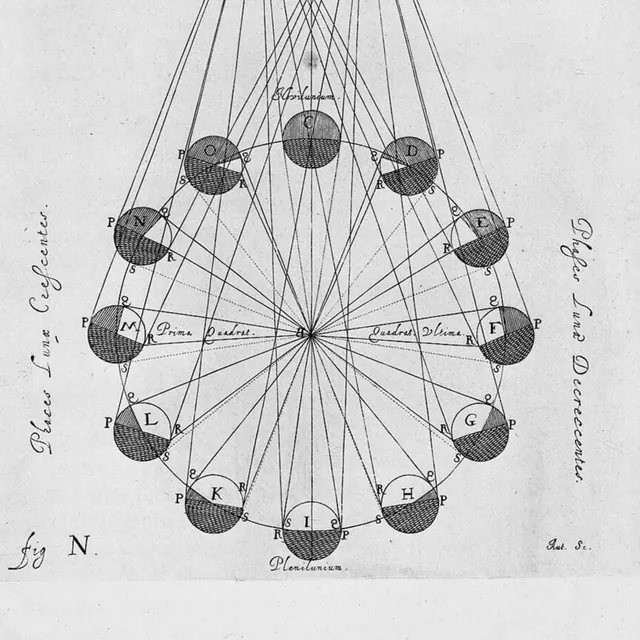
- A lunar eclipse always happens at the Full Moon and a solar one always at the New Moon, without exception across all 433. It is not a coincidence: it is the definition. The phases are in the phases of the Moon.
The dates on this page are the peak of the eclipse, in Brasília time. What you see of the sky depends on where you are: a total eclipse on the other side of the planet happens all the same, and simply does not show up in your window. The degree it falls in, though, is the same for everyone, and it is the degree your chart reads.
And the questions that come up most on this subject, with the short answer:
When is the next eclipse? The block at the top of this page answers by your device's clock, and the list below it carries the dates through 2028. They come in seasons: two a year, about 173 days apart, with two or three eclipses in each.
How many eclipses happen in a year? Four to seven. There were 433 between 1930 and 2025, an average of 4.51 a year. Sixty-two of those 96 years had exactly four, and only three years reached seven. An eclipse is not a once-a-decade event: it is the sky's routine.
How long does an eclipse last? At a total lunar eclipse, totality lasted between 13 and 107 minutes across the 90 times it happened between 1930 and 2035, averaging 71 minutes, and the partial phase around it comes to nearly four hours. At a solar eclipse the duration depends on where you are: the band in which it is total is a few hundred kilometres wide.
Why do eclipses happen every six months? Because there is an eclipse only when the New Moon or the Full Moon happens near one of the two lunar nodes, and the Earth passes them twice a year. The average gap between one season and the next is 173.4 days, measured across the 202 seasons between 1930 and 2025, almost six months, and that is why the dates move about nineteen days backwards each year.
What does an eclipse mean in my chart? It marks a degree, and what matters is what you have at that degree. The sky is the same for eight billion people; what changes is the house of your chart the eclipse falls in and the planet it touches, and that depends on the date, the hour and the city you were born in.
Questions for people just starting out
In short:
- How many a year four to seven, averaging 4.51
- How often two seasons a year, 173.4 days apart
- How many per season two, and sometimes three
- How long lunar totality, 13 to 107 minutes
- What decides it the Moon near a node, never more than 1.6 degrees of height away
An eclipse is the sky's routine, and what is not routine is where it falls. The degree is the same for the whole planet; the house it lands in is yours. See yours free here.