The lunar return happens when the Moon returns to the exact degree where it stood at your birth, every 27.3 days, and the chart of that instant can be read as the emotional tone of the month that begins. It is the monthly version of an old gesture of astrology, and it is worth knowing its numbers, its history and what remains as a question.
We measured the interval with the engine that builds the charts on this site, across 24 birth degrees spread around the zodiac throughout 2026. The average between two returns is 27.322 days, or 27 days, 7 hours and 43 minutes, and the interval runs from 27.22 to 27.48 days (from 27 days and 5 hours to 27 days and 12 hours). That is why the lunar return arrives about three days earlier each calendar month. The year has 12 calendar months and 13 or 14 lunar returns: in 2026, 15 of the 24 degrees tested had 13 returns and 9 had 14.
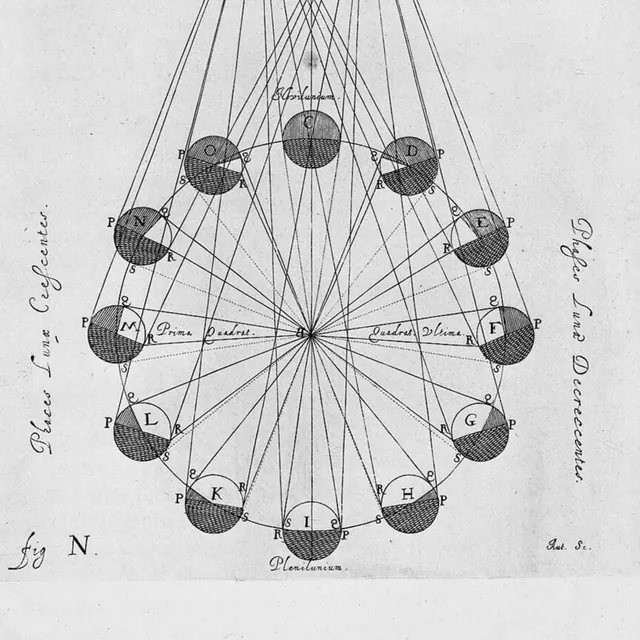
The lunar return is not the same thing as the new Moon or the phases. The phase measures the angle between the Moon and the Sun and takes 29.5 days; the return measures the position of the Moon in the zodiac and takes 27.3. The difference of about two days exists because, while the Moon goes around, the Sun also advances about 27 degrees, and the Moon has to run after it to close a phase. The text on The phases of the Moon has that other side of the conversation.
The gesture of redoing the chart when a star returns to its place is old. Abu Ma’shar, in the ninth century, wrote about the revolutions of the years of births, the basis of the solar return, and the lunar return is the same movement on a monthly scale. The Solar return reads the year; the lunar return reads the month.
The Moon, in astrology, speaks of emotions, habits, memory, home and body, and so the return chart is read through the Moon itself: the sign shows the climate, the house shows the area of life where the feeling of the month concentrates, and the aspects show who or what it is talking to. The position of the Moon barely depends on where you are, with a difference of up to about 1 degree; the Ascendant and the houses do depend on it, and that is why the return chart is calculated for the city where you will be that month.
Your natal Moon also occupies one of the 28 lunar mansions, and the return is the moment when it goes back to that mansion. The calculation is in Lunar mansions: divide the Moon's longitude by 12.857 and round up.
What human question lives here? Perhaps the one about how one returns to oneself. Augustine wrote in the Confessions: “I became a question to myself.” A monthly return is a regular occasion to ask that question again in small: how am I, what do I need, what has been asking for attention since last month? We can read the return chart as an invitation to ask, and the answer remains yours.
The limits. No study shows that the lunar return changes mood, sleep or the events of the month. The 27.3-day duration resembles that of the menstrual cycle, which makes for conversation, but there is no proof that the rhythm of the Moon commands that cycle. The chart is a symbolic lens for organizing attention, and a hard month of sleep, mood or health calls for professional care, with or without the Moon.
A simple practice is to write down, on the day of the return, how you feel, what is at the center of your thoughts and what you intend to look after. After three returns you have a notebook of your own, which may show a pattern or may show nothing, and both answers are useful.
Lunar return · R$ 29,90
Every month the Moon returns to the degree of your birth and opens a new emotional month. See the chart of your next month, calculated for the city where you will be.
If you would like to follow the Moon month by month, the Lunar return shows the chart of the month that begins each time the Moon returns to your birth degree, calculated for the city where you will be. And the Solar return: forecasts for your year does the same for the year.
The question that remains is: what would you like to ask yourself every month, always on the same date?
A few questions that tend to come up about the lunar return:
What is the lunar return? It is the moment when the Moon returns to the degree of the zodiac where it stood at your birth. It happens every 27.3 days, and the chart of that instant is read as the tone of the month that begins.
How often does the lunar return happen? The average is 27 days, 7 hours and 43 minutes, and each interval varies from 27.22 to 27.48 days. In 2026, depending on your Moon degree, there are 13 or 14 returns.
What is the difference between the lunar return and the new Moon? The new Moon marks the meeting of the Moon with the Sun and repeats every 29.5 days. The lunar return marks the Moon's return to your birth degree and repeats every 27.3 days. They are different cycles and almost never coincide.
Do I need my birth time to know the lunar return? It helps a lot. The Moon moves about 13 degrees a day, so without the time its degree varies by up to 13 degrees and the instant of the return shifts by up to about a day. The time also defines the Ascendant and the houses of your chart.
Does the lunar return predict what will happen in the month? No. It describes the emotional climate and the areas of life that ask for attention, like a symbolic lens. There is no study showing that the lunar return changes the events of the month.
In short, the lunar return is the Moon's return to your birth degree, every 27 days, 7 hours and 43 minutes on average, with 13 or 14 returns a year. It differs from the phases (29.5 days) and uses the chart of the month, calculated for the city where you will be, as a symbolic lens for emotional attention, without predicting what happens.
Keywords lunar return, Moon, 27.3-day cycle, chart of the month, lunar revolution
If what you want is this read in your chart, with the Moon of the month and the degree of your birth, that is what you get from the reading Lunar return. See the reading