The intermediate birth chart adds to the Sun, the Moon and the Ascendant all the other planets, from Mercury to Pluto, each read as a function of the psyche, and it shows the whole cast that lives in a person: who thinks, who loves, who desires, who demands, who breaks away. It is worth understanding what each planet now has to say, where this way of reading comes from, and what the measurements show about real charts.
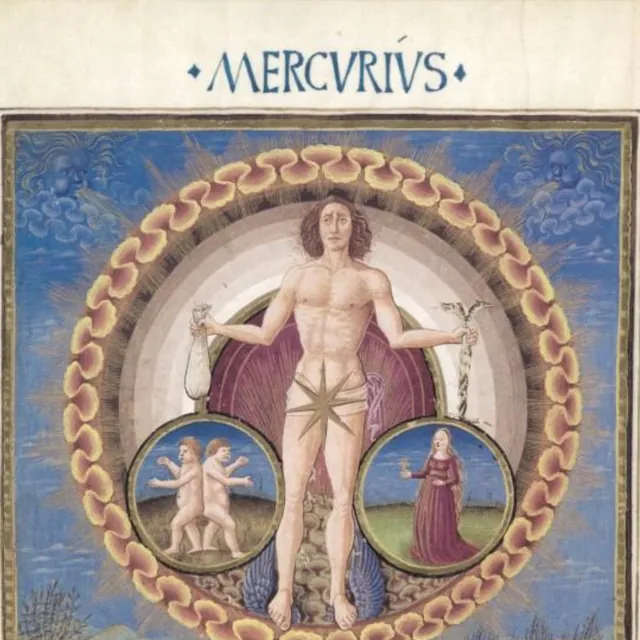
The basic chart presents three pillars, identity, emotions and the way of arriving, plus the temperament of the chart given by element and modality. The intermediate one opens the door to the rest. The reading is psychological, Jungian in inspiration: each planet is an inner function and an archetype, a figure with a will of its own, and it is read without the idea of destiny. Mercury is thought and language; Venus, value and bond; Mars, impulse and will; Jupiter, the search for meaning; Saturn, the limit and the fear that matures; Uranus, the impulse to break with the expected; Neptune, imagination and the longing for something greater; Pluto, power and the renewal that passes through a symbolic death. Each one is read through the sign and the house where it stands.
The word planet comes from the Greek planetes, “wanderer”: the five bodies that moved among the fixed stars, plus the Sun and the Moon, were the seven wanderers of ancient astrology. Uranus was discovered in 1781 by William Herschel, Neptune in 1846, from the calculations of Le Verrier and the observations of Galle, and Pluto in 1930, by Clyde Tombaugh. It was in the twentieth century, with astrologers such as Dane Rudhyar, that astrology began to read the planets as processes of the personality, and Jung's psychology gave this movement the vocabulary of archetype, shadow and individuation.
We measured a few facts that change how a chart is read, with the engine that builds the charts on this site, in 586 births spread from 1930 to 2015. Starting with retrogrades: on average, 2.3 of the eight planets from Mercury to Pluto are retrograde at birth; 89.9% of charts have at least one and 10.1% have none; 43.9% have three or more. By planet, Mercury is retrograde in 19.8% of charts, Venus in 7.2%, Mars in 9.9%, Jupiter in 30.4%, Saturn in 36.3%, Uranus in 41.1% and Neptune and Pluto in 43.5%. Having a retrograde planet is, then, common, and the psychological reading treats it as a function that works more inwardly than outwardly.
Another measurement undoes a common idea. Mercury never moves more than about 28 degrees away from the Sun, and Venus, about 47. In the 586 charts, Mercury was in the same sign as the Sun in 53.9% and, in the rest, always in the neighboring sign; Venus was in the same sign in 22.4%, within one sign in 82.1% and within two in 100%. Someone with the Sun in Taurus has Mercury in Aries, Taurus or Gemini, and the reading of thought almost always rests on the same color as identity. Mars, Jupiter and Saturn, on the other hand, can be in any sign, and that is where the intermediate chart tells two people with the same Sun apart the most.
The slow planets call for another kind of care. Uranus stays about seven years in each sign, Neptune about fourteen and Pluto between about twelve and more than thirty, and so a whole generation shares their sign. The personal reading of Uranus, Neptune and Pluto comes from the house they are in and from the contacts with the personal planets, and the sign enters as the climate of the generation.
What human question lives here? Perhaps how one person can be many. Spinoza wrote in the Ethics: “An affect cannot be restrained nor removed unless by an opposed and stronger affect.” A chart with all the planets is an image of this contest between inner forces, in which a function is balanced only when it meets another of similar weight. We can ask which voices usually speak first inside us and which wait their turn.
The limits. No study shows that a planet in a sign determines a character trait, and the psychological reading does not diagnose or replace therapy. What it does is offer a vocabulary for looking inward: the light, what the function gives when it is lived with awareness, and the shadow, what it produces when it is denied, exaggerated or projected onto others. Without the birth time, the intermediate chart still reads the planets, with the caveat that the Moon may be in one of two signs on that day and the houses are left out.
A simple practice is to choose one planet and ask how that function shows up in your week: when your Mars acts, when your Saturn stalls, when your Venus draws close. Naming the function, instead of the person who carries it, is the first step of the reading.
Intermediate Birth Chart · R$ 59,90
Get to know the planets in your chart and understand your way of thinking, loving, acting and relating.
If you want to see the cast of your chart, the Intermediate birth chart shows the planets in your chart and your way of thinking, loving, acting and relating. To start with the three pillars, the Basic birth chart presents identity, emotions and the way of arriving, and the Advanced birth chart adds the areas of life.
The question that remains is: which of your inner voices do you usually let speak last?
Some questions that usually come up about the intermediate birth chart:
What does the intermediate birth chart show beyond the basic one? The basic one reads the Sun, the Moon, the Ascendant and the temperament of the chart. The intermediate one adds all the other planets, from Mercury to Pluto, each read as a function of the psyche, in the sign and house where it stands.
Is having a retrograde planet unusual? No. In 586 measured births, 89.9% of charts had at least one retrograde planet between Mercury and Pluto, and on average there were 2.3 per chart. The psychological reading treats it as a function that works more inwardly.
Can my Mercury and my Sun be in different signs? They can, but only in neighboring signs. Mercury never moves more than about 28 degrees away from the Sun, so it stays in the same sign or in the next one. In the measurement, 53.9% of charts had both in the same sign.
Do Uranus, Neptune and Pluto say something about me or about my generation? Both. Their sign is shared by a whole generation, because each one stays years in the same sign. The personal reading comes from the house they are in and from their contacts with your personal planets.
Do I need my birth time for the intermediate birth chart? It helps, but the planets can be read without it. Without the time, the Moon may be in one of two signs on that day, and the Ascendant and the houses are left out of the reading.
In short, the intermediate birth chart adds to the basic one all the planets from Mercury to Pluto, read as functions of the psyche and archetypes, in the sign and house where they stand. In the 586 charts measured, 89.9% had at least one retrograde planet, Mercury stayed in the same sign as the Sun in 53.9% and always next to it, and the useful reading is the one that names the function, with light and shadow, without diagnosis.
Keywords intermediate birth chart, planets, retrograde planet, functions of the psyche, Mercury, Venus, Mars
If what you want is this read in your chart, with all the planets, from Mercury to Pluto, as functions of the psyche, that is what you will find in the reading Intermediate birth chart. See the reading