The short answer
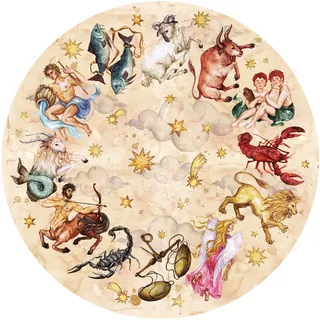
Two earth signs who disagree about what care looks like. By the rule of elements, Taurus is earth and Virgo is earth — and the rule approves this pair. Keep that in mind and read on, because the rule answers far less than it seems to.
Earth with earth is the match the tables praise most, and here it's real: both prefer the thing done to the thing said, both distrust enthusiasm with no deadline attached, and neither needs drama to feel alive. Practical life runs almost on its own — bills paid, the house in order, commitments kept. This is the pair that fights least over money, because both share the same wariness of big spending and the same patience for saving up.
What the element rule says, and what I measured
The table every magazine publishes is simple: fire matches fire and air, earth matches earth and water. It was not invented yesterday, and it has a geometric reason — signs of the same element sit 120 degrees apart, and allied elements sit 60 degrees apart. Those are the trine and the sextile, the two aspects that tradition calls harmonious. The compatibility table is the aspect table applied to a single planet.
It puts half the zodiac on each person's list, which already shows how little information that is. And it can be tested against the numbers. I drew a random sample of 600,000 pairs of birth dates between 1966 and 2025, using the same ephemeris that builds charts on this site, and asked: in the pairs the rule approves, do the other pieces follow along?
| Between any two charts | Pairs the rule approves | Pairs it fails |
|---|---|---|
| The Moons match up | 49.8% | 50.0% |
| There's a Sun–Moon contact | 46.4% | 46.4% |
| There's a Venus–Mars contact | 46.1% | 46.2% |
| Contacts between the two charts | 26.7 | 26.6 |
The columns are the same. Knowing that the rule approves or fails your pair tells you nothing about the other person's Moon, nothing about desire, and nothing about how many contacts the two charts have. And 50.0% is exactly what a coin toss would give you.
That does not make the table false. It makes it small: it describes a trait of temperament, read from a single point on the chart. Using it to decide who to date is reading a book by its title's first letter.
Taurus and Virgo in practice: where this pair gets stuck
The blind spot is what each one calls care. Virgo cares by correcting: it points out what could be better, and to Virgo that IS affection. Taurus cares by accepting: it leaves things as they are, and to Taurus that's what affection looks like. So Virgo hands over love in the shape of a fix, and Taurus receives it in the shape of criticism — every day, over small things, with neither one able to name what's happening. Taurus doesn't react on the spot; it stores things up. And when it finally speaks, it speaks three years' worth all at once, and Virgo has no idea where that came from.
What gives this pair its ground is the Moon, because the Moon decides whether the correction lands as help or as attack. A Moon in a water sign in either of them changes the temperature of the whole house — and a Moon in Virgo on Taurus's side turns Taurus into someone who also corrects, which fixes the imbalance and creates another one.
What usually unblocks things: Virgo saying out loud that it's care, right when it corrects. It sounds like a small thing and it changes the whole reading — Taurus doesn't infer intention, it hears the sentence. And on the other side, Taurus needs to complain early. The three-year tab isn't steadiness: it's a debt collected all at once from someone who never knew they owed anything. An irritation named the week it's born costs one conversation; the same irritation stored away costs a whole weekend.
Your Moon changes sign every two and a half days, and your Ascendant every two hours. It's the difference between "we're Taurus and Virgo" and knowing what the two of you actually are.
Generate my chart for freeWhat the element table doesn't look at in this pair
The element rule reads one thing only: the element. Each sign carries two other labels the table ignores, and in both cases they say more about the day-to-day than the element does. The modality — cardinal, fixed or mutable — is the way a person goes into a subject: cardinal starts it, fixed holds it, mutable changes it. And the ruler is the planet that gives the sign its vocabulary.
Taurus is fixed and ruled by Venus; Virgo is mutable and ruled by Mercury.
Fixed with mutable, and it's the combination where the mutable sign looks like the organised one. Virgo keeps changing method — another app, another routine, another way of storing things — and calls that improving. Taurus picks one way and stays with it for life. Both think of themselves as practical and define practical in opposite ways: for Virgo, practical is what works best; for Taurus, it's what already works.
Venus and Mercury are the only two planets that never stray far from the Sun, and it's the only pair of rulers built that way. One wants the thing to be good, the other wants the thing to be right. It's not the same wish, and the difference shows up at the moment of choosing: Taurus picks what gives pleasure and justifies it after; Virgo picks what the analysis approves and sometimes ends up with a correct house nobody wants to spend the afternoon in.
The one thing your sun sign decides about the other person
There is one exception to "the table tells you nothing", and it comes down to pure geometry. Venus never moves more than 47.2 degrees from the Sun — it is an inner planet, and from Earth's point of view it stays tied to the Sun's light. Given your sun sign, your Venus can only fall in five signs.
So the distance between two sun signs decides the odds that both Venuses land in the same sign. Measured across the same 600,000 pairs:
| Signs apart | Aspect | Both Venuses in the same sign |
|---|---|---|
| 0 (the same sign) | conjunction | 24.3% |
| 1 sign | semi-sextile | 19.2% |
| 2 signs | sextile | 12.9% |
| 3 signs | square | 5.5% |
| 4 signs | trine | 0.8% |
| 5 or 6 signs | quincunx and opposition | 0.0% |
Taurus and Virgo sit 120° apart — a trine — and that puts this pair in the 0.8% bracket. In other words: your two Venuses almost never land together, and that is the only thing the distance between your Suns actually determines.
Notice what the table does with the element rule: it cannot follows the rule. Pairs the rule fails come out on top of the list, and pairs it approves come out at the bottom. The Venus link is real, and it is geometric — and it is why the compatibility table sometimes seems to work. It works a little, and not for the reason it claims to.
What no sign table can reach
Four pieces that change everything, and that no sun-sign table can reach:
- Each person's Moon. It is the way you feel, need and settle down — the piece that most decides day-to-day life together. It changes sign every two and a half days.
- The Ascendant. It changes every two hours and depends on the city. Two people born on the same day, both Taurus, can arrive at a party in opposite ways.
- The house each one falls into on the other's chart. The same Venus in your house 5 and your house 12 is passion in one case and a private matter in the other. This layer needs both people's birth time.
- What each one has already lived. Age, past relationships and the timing of the meeting weigh more than any aspect — and none of it is in anyone's chart.
This crossing is what's called synastry, and it needs both people's date, time and city of birth. Comparing sun signs is what's left when you don't have that.
And the limit stated out loud still holds: astrology decides nothing for anyone, doesn't tell you to stay or leave, and doesn't replace conversation or therapy. It gives you vocabulary. A couple who discover that one Moon needs routine and the other needs novelty have gained a better question than they had before.
Frequently asked questions about Taurus and Virgo
Do Taurus and Virgo work?
By the rule of elements, yes: Taurus is earth and Virgo is earth. But that rule reads one point on the chart out of the ten that exist. I measured 600,000 pairs of birth dates: among the ones the rule approves, the Moons match 49.8% of the time; among the ones it rejects, 50.0%. Chance sits at 50%. Your sun signs don't tell you whether the relationship works.
What is the aspect between Taurus and Virgo?
120°, which tradition calls a trine. That is where the rule of elements comes from — it is the aspect table applied to a single planet. Signs of the same element sit 120 degrees apart, allied elements sit at 60, and the rule rejects the rest.
Can a Taurus's Venus be in Virgo?
Almost never: 0.8% of the time. That window is the only thing your sun signs actually decide about each other's charts.
So what decides whether two people are compatible?
The crossing of the two full charts, which is what's called synastry: one person's Moon with the other's Sun, one person's Venus with the other's Mars, and the house each one falls into on the other's chart. None of that comes off a sign chart — it needs both people's date, time and city of birth.
Do any two charts have few contacts between them?
Quite the opposite: the average is 26.6 contacts between two charts, with a 6-degree orb, and across 600,000 randomly drawn pairs none came out at zero. That's why "we have so many aspects!" means nothing on its own. What a reading does with the 26.6 is weigh them, not add them up.
Taurus and Virgo in short
Keywords earth with earth, correction as affection, the debt kept on file
The numbers on this page hold for any pair of people, because they come from the sky. What does not show up in them is your case. Two charts bring 26.6 contacts on average, and what a reading does with them is weigh — which are exact, which involve the Moon, which fall in a house that matters. Without both birth dates, times and cities, this page describes two signs, not two people.
