The complete birth chart adds the aspects, which are the relations between the planets, and it is in them that the reading shows the inner conflicts, the compensations and the integrations of a personality. What is read in them, the history of each one and how many a chart usually has are below.
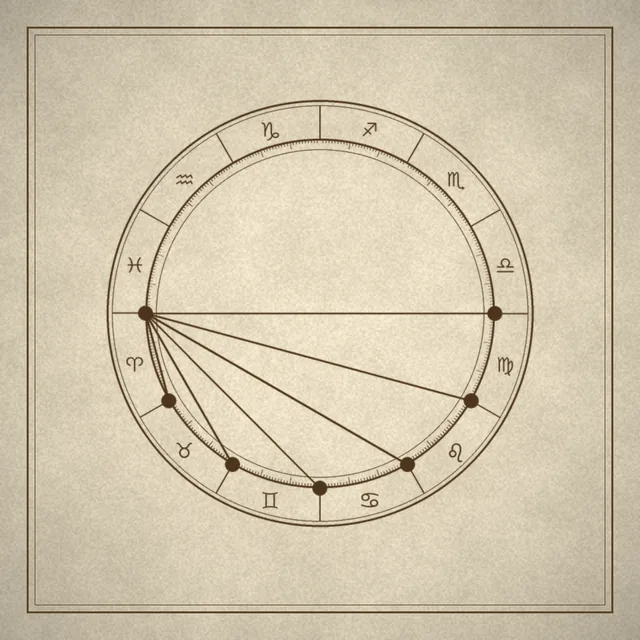
The basic one reads three pillars; the intermediate, the planets as functions; the advanced, the houses, the areas of life. The complete one reads what happens between the functions. An aspect is the angle between two planets in the zodiac, and the five main ones are the conjunction (0°), the sextile (60°), the square (90°), the trine (120°) and the opposition (180°). In the psychological reading, the conjunction fuses two functions, which act together and are hard to separate; the opposition shows two functions that a person tends to live one at a time, often projecting one of them onto others; the square is an inner friction that asks for development; the trine is a function that flows so naturally that it can operate without being chosen; the sextile is an available cooperation, which only pays off when the person takes the initiative.
Ptolemy describes in the Tetrabiblos the opposition, the trine, the square and the sextile, and Kepler, in Harmonices Mundi, in 1619, added smaller angles. Modern astrology separated the aspects into those that flow and those that create tension, and Jung's psychology gave them the vocabulary of polarity: two forces that each person carries and either recognizes as their own or projects onto others.
We measured how many aspects a chart has, with the engine that builds the charts on this site, in 586 births from 1930 to 2015, with the five main aspects and an orb of 8 degrees when one of the planets is the Sun or the Moon and 6 degrees for the rest. The average is 13.5 aspects per chart, among the ten planets; the smallest chart had 7 and the largest 30, and 80% fell between 10 and 18. On average, each chart has 2.75 trines, 3.14 squares and 1.37 oppositions. A chart is never only flow or only tension: the normal is to have both, in similar proportion.
This count changes what it means to read the aspects. With more than thirteen relations per chart, nobody can read them all with the same weight, and the useful reading chooses: the exact aspects, those involving the Sun, the Moon and the Ascendant, and those that repeat in a pattern, such as several planets in tension with a single one. Orbs vary from author to author, and the number above depends on them; with smaller orbs, the average drops.
What human question lives here? Perhaps how to separate what matters from sheer quantity. Montaigne wrote in the Essays: “A well-made head is better than a well-filled one.” A chart with thirteen aspects calls for a well-made reading, one that chooses what to name and leaves the rest in the background. We can ask which polarities we recognize as ours and which we usually see only in others.
The limits. No study shows that an aspect determines a relation between traits, and the reading is a symbolic lens for looking at conflicts and talents. A trine is not a guarantee and a square is not a sentence: the trine can go unused, and the square becomes strength when it is faced. The psychological reading does not diagnose, and suffering that weighs heavily calls for professional care.
A practice: choose the exact aspect of your chart, the one with the smallest orb, and write the two functions in your own words. Where do they help each other, where do they quarrel, which of them do you usually see only in other people?
Complete Birth Chart · R$ 129,90
Go deeper into the relationships between planets, houses and aspects to understand the dynamics and contradictions of your chart.
If you want to see the relations within your chart, the Complete birth chart shows the relations between planets, houses and aspects, to understand the dynamics and the contradictions. Before it, the Advanced birth chart reads the areas of life, and the Shadow Chart investigates the parts of yourself that you hide or avoid.
The question that remains is: which of your own polarities do you usually see only in others?
Some questions that usually come up about the complete birth chart and the aspects:
What does the complete birth chart show beyond the advanced one? The advanced one reads the planets and the twelve houses. The complete one adds the aspects, the relations between the planets, and with them the inner conflicts, the compensations and the integrations of the personality.
What are the five main aspects? The conjunction (0°), the sextile (60°), the square (90°), the trine (120°) and the opposition (180°). Each one describes a kind of relation between two functions of the chart, from fusion to friction and cooperation.
How many aspects does a chart usually have? In 586 measured births, with an orb of 8 degrees for the Sun and the Moon and 6 for the others, the average was 13.5 main aspects per chart, between 7 and 30. The count changes with the orbs used.
Is a square bad and a trine good? It is not that simple. The square is a friction that asks for development and becomes strength when it is faced, and the trine is a talent that can go unused. The tradition separates them into tense and flowing, without judging.
Can a chart have no aspects at all? In the measurement of 586 charts, the smallest had 7 main aspects, so it is very unusual. When few planets form aspects, the reading tends to give more weight to the houses and the signs.
In short, the complete birth chart adds the main aspects (0°, 60°, 90°, 120° and 180°), which are the relations between the planets and show conflicts, compensations and integrations. A chart has on average 13.5 of them, with 2.75 trines, 3.14 squares and 1.37 oppositions in the 586 charts measured, and the useful reading chooses the exact aspects and the patterns instead of reading them all with the same weight.
Keywords complete birth chart, aspects, square, trine, opposition, orb, Ptolemy
If what you want is this read in your chart, with the relations between planets, houses and aspects, that is what you will find in the reading Complete birth chart. See the reading