Astrology in Italy
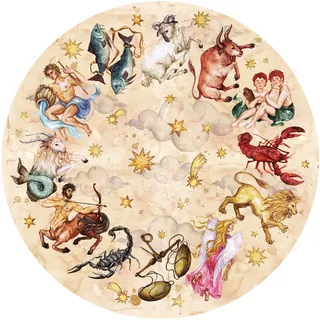
In Italy astrology was a philosopher's subject, and it had its finest enemy.
Italy did for astrology something no other place did: it put astrology at the centre of a serious philosophical debate about the nature of the world — and produced, in the same century, both its most sophisticated defence and its harshest attack.
Before that, in the thirteenth century, Guido Bonatti left behind a treatise that organised medieval practice and circulated across all of Europe. He was astrologer to cities at war, and his fame reached far enough for Dante to place him in Inferno, among the diviners who walk with their heads turned backwards — punishment for those who wanted to see what lay ahead. Dante knew astrology well: the structure of the Divine Comedy rests on the planetary heavens.
In the fifteenth century, Marsilio Ficino, in Florence, wrote about how to use planetary qualities in daily life — choosing music, colours, foods and hours according to the planet one wants to call on. It is the learned root of what is now called astrological magic, a subject this blog covers in a page of its own.
And it was a student from Ficino's circle who wrote against it. Pico della Mirandola produced a twelve-book refutation of astrology's claim to predict fate, with arguments still used today: astrologers disagree among themselves, they get verifiable predictions wrong, and they attribute to the planets causes better explained by other means. The strongest attack on astrology came from within the very place that took it most seriously.
Girolamo Cardano, a sixteenth-century physician and mathematician, published collections of well-known people's charts with commentary — an old form of what would now be called a case study. Italy was also where the tension with the Church showed most clearly: popes consulted astrologers, and popes condemned astrology, sometimes in the same century.
What Italy gave to astrology
Italy gave astrology its learned layer — the question of what it means, asked by people who also knew how to calculate, and the best-written objection it has ever received.
Five things about Italy's sky
In Ferrara there is a room that is an astrological treatise painted on the wall. The Palazzo Schifanoia has the Hall of Months, from the fifteenth century, with each month in three bands: at the top the Roman god in procession, at the bottom court life, and in the middle a band of strange figures that for centuries nobody could explain. They are the decans — the three ten-degree divisions of each sign —, and the figures got there through Arabic treatises that in turn had gathered images of Indian origin.
The one who worked this out was the art historian Aby Warburg, in the early twentieth century. The wall in Ferrara is the map of the journey astrology made: an image born in India, written down in Arabic, translated in the West and painted in an Italian palace by a painter who probably had no idea where it came from.
In Florence there are two domes with the sky of one particular night. In the Old Sacristy of San Lorenzo and in the Pazzi Chapel, stars and planets sit in positions matching a specific date in the fifteenth century — the most accepted proposal is 4 July 1442, and there is still debate over why that date. It is not a decorative sky: it is a chosen moment set down in stone, for the same reason someone writes down the hour of a birth.
Galileo drew up birth charts on commission, and charged for it. They are in his archive, written in his own hand, including those for his two daughters and for patrons who requested them. He taught astrology as part of the medicine course in Padua, which was what was expected of a mathematics professor at the time. Anyone who imagines modern science beginning with a clean break from astrology has to explain that handwriting.
The most extraordinary case involves a pope. Word went round Rome, in the late 1620s, that the stars foretold the death of Urban VIII, and astrologers were talking about it. The pope summoned Tommaso Campanella, who carried out with him an astrological magic ritual in the line of Ficino — a sealed room, white cloths, torches and music, meant to mimic a favourable sky and stand in for the eclipse happening outside. Shortly after, in 1631, came the bull Inscrutabilis, which condemned judicial astrology with unprecedented harshness.
It is worth reading the sequence in order: the pope used astrology to defend himself from it, then banned it. The harshest condemnation came from the very man who had just resorted to the ritual. It is a portrait of the place astrology held — taken seriously enough to be frightening.
And there is an astronomical instrument inside an Italian church, which is the best possible close for this section. In the basilica of San Petronio, in Bologna, Cassini installed in 1655 a meridian line: a hole high in the nave lets in a ray of sunlight that falls on a metal strip on the floor, marked with the signs. The length is such that you can follow, day by day, the Sun's position with good accuracy. It served the calendar — the date of Easter — and it is still there. A sundial the size of a cathedral, with the zodiac on the floor, inside the building of the institution that condemned judicial astrology.
There is an Italian word of astrological origin that the whole world repeats every winter without thinking about it. Influenza is the name of a disease because Italian doctors attributed epidemics to the influence of the stars — the same influxus as the France page. When someone says they have the flu, they are repeating a sixteenth-century astrological diagnosis.
The University of Bologna had a post of astrologer with a contractual obligation: whoever held it had to publish every year a judgement on what to expect in the months ahead, for the city. It was a public office, with a deadline and a delivery — and it forced them to be wrong in writing, in an archived document, which is more than most practitioners today accept.
And it was in Bologna that a Polish student lodged in the house of the astronomer Domenico Maria Novara and helped him with observations. The student was Copernicus. The man who came to move the Earth from the centre of the world learned the craft alongside someone whose job included producing forecasts, at the university that paid for them.
And there is in Rome a birth chart painted on the ceiling of a room. At the Villa Farnesina, the banker Agostino Chigi had Peruzzi cover the entrance vault with the figures of the sky in the exact position of his birth. Historians worked out the date from what is painted and arrived at 1466. It is not allegory: it is the birth chart of a living man, at ceiling scale, made so that whoever walked into the house could see whose destiny that was.
And the sky over Rome is different — this can be measured
The part of astrology that depends on PLACE, not just date, is the Ascendant: the degree of the zodiac rising on the horizon at the moment of birth. It changes every two hours and depends on the city's latitude.
And the twelve signs do not rise at the same speed. Some take more than two hours to cross the horizon and others less than one, and that difference grows the farther you get from the equator. I drew 200,000 random moments between 1950 and 2010 and worked out the Ascendant for Rome, at 42° north:
| In Rome, 42° north | Measured |
|---|---|
| The most common Ascendant | Scorpio, 10.8% |
| The least common | Pisces, 4.8% |
| How many times more likely one is than the other | 2.3× |
| If the draw were fair | 8.3% for each |
Notice what this means: two people born at exactly the same time, one in Rome and one in a city at another latitude, can have different Ascendants — and the frequency of each Ascendant changes with the place. The city of birth is not an administrative detail on a form: it enters into the count.
The pattern across this series is pure geometry, and it fits in one sentence: the further from the equator, the more uneven the draw. In Copenhagen, at 56 degrees north, the gap between the most common Ascendant and the least common one is 4.3 times; in São Paulo, at 23 degrees south, it drops to 1.5.
Your Ascendant depends on the time and city where you were born, and no sun sign table gets you there. These are two facts only the calculation can give you.
Generate my chart for freeFrequently asked questions
Does astrology in Italy have its own history?
Italy did for astrology something no other place did: it put astrology at the centre of a serious philosophical debate about the nature of the world — and produced, in the same century, both its most sophisticated defence and its harshest attack. Before that, in the thirteenth century, Guido Bonatti left behind a treatise that organised medieval practice and circulated across all of Europe.
Why does latitude change the Ascendant?
Because the Ascendant is the degree of the zodiac rising on the horizon, and the signs do not all rise at the same speed. The farther from the equator, the bigger the difference: some signs take more than two hours to rise and others less than one. Near the equator the draw is nearly fair; near the pole, some signs barely show up.
Does this mean my rising sign is common or uncommon?
It means the count depends on where you were born, not just when. Two people born at the same hour in cities at different latitudes can have different Ascendants — and the frequency of each one changes with the place. It is one of the reasons a chart needs the city, not just the date.
Where can I see my Ascendant?
In your birth chart, which this site calculates for free from your date, time and city of birth. The Ascendant changes every two hours, so the time matters: an error of two hours can flip the whole sign.
Astrology in Italy, in brief
Keywords Ficino, Pico della Mirandola, Bonatti
The numbers on this page hold for anyone born in or near Rome, because they come from the latitude. What they do not give you is your Ascendant. It changes every two hours, and without the birth time there is no way to know which one is yours — the frequency of each one describes the population, not you.
