Astrology in France
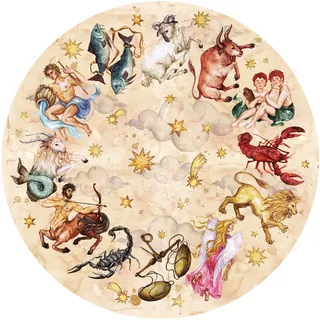
France gave astrology its most systematic treatise — and the first attempt to measure it.
The 16th-century French court was one of the places where astrology stood closest to power. Catherine de' Medici, Italian by birth, brought to France the Florentine taste for the subject, and Nostradamus is the name everyone knows from that period. It is worth separating what he was from what he became: a physician and astrologer, consulted by the queen, and the author of deliberately obscure prophetic verses that today overshadow the rest of his work.
Less well known and far more important for the technique is Jean-Baptiste Morin de Villefranche, astrologer to Louis XIII and author of the Astrologia Gallica, from the 17th century. His project was to organise astrology as a coherent system, derived from principles, instead of a collection of inherited rules each author repeated from the last. Anyone who studies technical astrology still argues about Morin, and still disagrees with him.
It is said that Morin was present at the birth of Louis XIV to note down the exact time. True or not, the episode says what matters about the period: the hour of a king's birth was a matter of State, because a reign's chart came out of it.
And there is a third chapter, from the 20th century, which comes closest to what this site is trying to do. Michel Gauquelin spent decades putting astrological claims to statistical test, with databases of thousands of births gathered from official records. Most of what he tested did not hold up — and he published that, which almost nobody does. Some correlations he found are still argued over today, with no agreement.
It is the attitude popular astrology lacks: measure, and say what the measurement answered, even when the answer is "no".
What France gave to astrology
France gave astrology Morin, who wanted to organise it from within, and Gauquelin, who wanted to test it from without. Both projects are more interesting than the prophecies that made him famous.
Five things about France's sky
Start with the words. Influence was an astrological technical term: the influxus, the fluid believed to flow from the stars into things down here. It passed into French and from French into other modern languages, and today it describes what one friend's opinion does to another's. It is in the same family as disaster — contrary star —, as jovial, as saturnine, as martial, as mercurial and from lunatic. The vocabulary outlived the doctrine, and it is spoken every day by people who believe none of it.
The court that consulted astrologers was also the one that banned them. After the Affair of the Poisons, which in the 1670s exposed a Parisian network of poisoners, fortune-tellers and potion-sellers tied to the nobility itself, Louis XIV signed an edict against divination in 1682. The text treated reading the future as fraud and placed it alongside poison and magic. It was not a debate about astronomy: it was policing.
A century later, the Revolution tried to remake time itself. The republican calendar of 1793 did away with the seven-day week — which is a list of planets, and still is in French: lundi is the Moon's day, mardi Mars's, mercredi Mercury's, jeudi Jupiter's, vendredi Venus's. In their place, ten days per decade and months named after the weather and the harvest: Germinal, Floréal, Brumaire.
Here a detour is worth taking: Portuguese is the exception in the family. Segunda-feira, terça, quarta — numbers standing where the gods used to be. The change is credited to Martin of Braga, a sixth-century bishop in the northwest of the peninsula, who preferred liturgical names to planetary ones. French kept the planets, and the Revolution had to fight them; Portuguese had already lost them a thousand years earlier, by decision of the Church.
And even so, the republican new year began at the September equinox, calculated for the Paris meridian. They tried to take the planets out of the calendar and were left with the Sun, because without some event in the sky there is no way to start a year. It lasted thirteen years. The week of the planets came back, and it is still here.
Back to the twentieth century: what Gauquelin found has a name and still draws argument. He noticed that, in the births of top-level athletes, Mars showed up slightly more often than expected right after birth or at culmination — the two regions astrology calls angular. The effect is small, it only shows up in large samples, and it has been the target of several attempts at replication, with results the two sides still read differently to this day.
Two things deserve to be said plainly. The first: the rest of what Gauquelin tested — sun sign, aspects, couple compatibility — did not hold up, and he published that. The second: even the part that held up gives no grounds for a newspaper column, because it speaks of a statistical tendency across a whole population, not of what will happen to one person on a Tuesday.
Before him, Paul Choisnard had already tried the same thing earlier in the century, with smaller samples and a weaker method. France has this lineage of its own: people who chose to count instead of argue. It is the lineage this page tries to fit into — from here on, only numbers.
Paris had its own meridian, and fought for it. The Observatory was founded in 1667, with Cassini at its head, and the line running through it was the French reference for longitude for more than two centuries. France only officially accepted the Greenwich meridian in 1911 — and even then, for a while, the law was written referring to "Paris time, retarded by nine minutes and twenty-one seconds". Every birth chart depends on a reference time, and which one that is was a matter of diplomacy.
And the oldest fully drawn zodiac known is in Paris. The ceiling of a temple at Dendera, in Egypt, was sawn out and taken to France in 1821, and today it is in the Louvre: on it the twelve signs appear in the full circle, already in the form the Greek tradition would fix. The piece's arrival caused a violent public row, because the first estimates made of its age contradicted the accepted biblical chronology. A stone with twelve drawings on it cast doubt on the age of the world.
And Nostradamus's image is worth correcting with a piece of bookkeeping: what he published every year, and what brought him regular money, were almanacs — calendar, weather, harvest and general predictions, in the same cheap format the series describes on the page about the Netherlands. The Prophecies in verse are the part that became famous; the daily bread was the little yearly booklet sold at fairs.
And the sky over Paris is different — this can be measured
The part of astrology that depends on PLACE, not just date, is the Ascendant: the degree of the zodiac rising on the horizon at the moment of birth. It changes every two hours and depends on the city's latitude.
And the twelve signs do not rise at the same speed. Some take more than two hours to cross the horizon and others less than one, and that difference grows the farther you get from the equator. I drew 200,000 random moments between 1950 and 2010 and worked out the Ascendant for Paris, at 49° north:
| In Paris, 49° north | Measured |
|---|---|
| The most common Ascendant | Scorpio, 11.5% |
| The least common | Aries, 4.0% |
| How many times more likely one is than the other | 2.9× |
| If the draw were fair | 8.3% for each |
Notice what this means: two people born at exactly the same time, one in Paris and one in a city at another latitude, can have different Ascendants — and the frequency of each Ascendant changes with the place. The city of birth is not an administrative detail on a form: it enters into the count.
The pattern across this series is pure geometry, and it fits in one sentence: the further from the equator, the more uneven the draw. In Copenhagen, at 56 degrees north, the gap between the most common Ascendant and the least common one is 4.3 times; in São Paulo, at 23 degrees south, it drops to 1.5.
Your Ascendant depends on the time and city where you were born, and no sun sign table gets you there. These are two facts only the calculation can give you.
Generate my chart for freeFrequently asked questions
Does astrology in France have its own history?
The 16th-century French court was one of the places where astrology stood closest to power. Catherine de' Medici, Italian by birth, brought to France the Florentine taste for the subject, and Nostradamus is the name everyone knows from that period. It is worth separating what he was from what he became: a physician and astrologer, consulted by the queen, and the author of deliberately obscure prophetic verses that today overshadow the rest of his work.
Why does latitude change the Ascendant?
Because the Ascendant is the degree of the zodiac rising on the horizon, and the signs do not all rise at the same speed. The farther from the equator, the bigger the difference: some signs take more than two hours to rise and others less than one. Near the equator the draw is nearly fair; near the pole, some signs barely show up.
Does this mean my rising sign is common or uncommon?
It means the count depends on where you were born, not just when. Two people born at the same hour in cities at different latitudes can have different Ascendants — and the frequency of each one changes with the place. It is one of the reasons a chart needs the city, not just the date.
Where can I see my Ascendant?
In your birth chart, which this site calculates for free from your date, time and city of birth. The Ascendant changes every two hours, so the time matters: an error of two hours can flip the whole sign.
Astrology in France, in brief
Keywords Morin de Villefranche, Gauquelin, measurement
The numbers on this page hold for anyone born in or near Paris, because they come from the latitude. What they do not give you is your Ascendant. It changes every two hours, and without the birth time there is no way to know which one is yours — the frequency of each one describes the population, not you.
