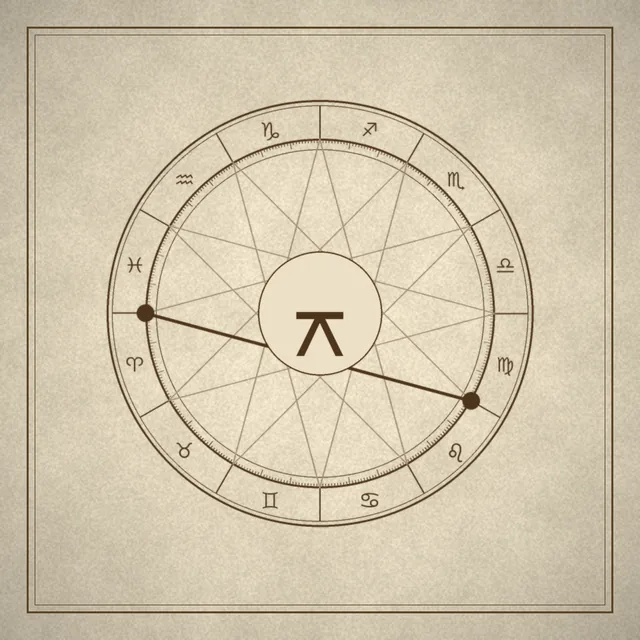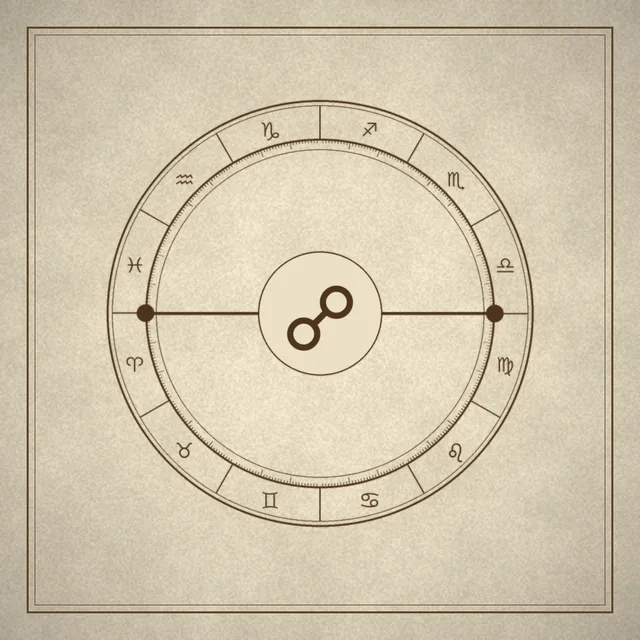
The opposition is the face-off: 180 degrees, the two planets at contrary ends of the wheel, each looking at the other from across the chart. It is the only aspect where both are always in signs of the same mode, two cardinal, two fixed or two mutable, and in elements that go together, fire with air or earth with water.
An aspect is the distance between two planets measured on the wheel of the zodiac. When that distance falls close to an angle the tradition recognises, the two are said to form an aspect, and that is what links one part of the chart to another. The whole logic is in what an aspect is.
I measured 200,000 charts drawn at random between 1930 and 2025, with the same orbs this site uses to cast charts and with the engine’s own rule: each pair of planets forms one one aspect, the tightest one.
The square (90°) appears 2.90 times per chart on average, is in 93.5% of charts and accounts for 23.4% of the five major aspects; the sextile (60°), 2.82 times, in 94.1% of charts and with 22.8%; the trine (120°), 2.68 times, in 92.9% and with 21.6%; the conjunction (0°), 2.47 times, in 93.9% and with 19.9%; the opposition (180°), 1.52 times, in 73.0% and with 12.3%; and the quincunx (150°), which stays out of the count of the five major ones, 0.93 times, in 58.2% of charts.
The opposition is the least frequent of the five, with 12.3%, and the reason is arithmetic: 180 degrees is ONE place on the wheel, while 60, 90 and 120 are two each, one on either side. The conjunction is also a single place and sits well above it, because the inner pairs (Sun with Mercury, Sun with Venus) live in conjunction and can never oppose.
And there is a number this measurement shows that almost no astrology text says out loud: 73.0% of charts have at least one opposition. Having one does not set many people apart. Not having one sets you apart more: that is 27.0% of charts. And what really distinguishes is WHICH planets it links, and which houses they are in.
The opposition sees from outside, and that is why it sees. It is the aspect of awareness: nobody notices their own nose, and notices very well the nose of whoever is in front of them. That is why the opposition usually arrives through someone else’s mouth, a person with Moon opposite Saturn does not think herself cold; she is told that she is.
The limit is worth saying: these are tendencies, not a verdict. An aspect describes how two functions of the chart talk to each other, it does not foretell events, diagnoses nobody and decides nothing for you.
The aspect on its own says almost nothing: what gives it a subject are the two planets. These four pairs are among the most common, and they show how the same geometry changes face:
- Sun–Moon: whoever is born at the Full Moon has who they are and what they need pulling in opposite directions, and this brings lucidity.
- Venus–Mars: wanting and going after it are out of step, and this often turns into attraction to people who don't reciprocate.
- Mars–Saturn: the push and the brake sit on opposite sides, and anger arrives together with a body that locks up.
- Moon–Uranus: the need for comfort and the need for freedom take turns, and never show up at the same time.
Notice that the angle is the same in all four and the subject is completely different. That is why "I have a opposition" is not a reading, it is the start of one.
Six of the 45 pairs never form an opposition, and it is the longest list of any aspect. Three are the inner planets, which do not get far enough from the Sun. The other three are the outer ones, which move so slowly that the distance between them barely changes in a century: Uranus and Neptune reached 145.9° and stopped; Neptune and Pluto never passed 65.3°. If a site showed you "Sun opposition Mercury", it did not calculate the sky.
This is not a rule of one school: it is the orbits of the planets. And it is a useful check at home, if a site shows one of those pairs with this aspect, it is not calculating the sky.
Two planets almost never fall on the exact angle. The orb is the leeway allowed: how far off the angle the aspect can be and still count. And it does not belong to the aspect alone, it depends on who forms it.
This site uses a wider orb for the Sun and the Moon, a narrower one for the outer planets, and takes the average of the two. Measured across the same 200,000 charts: when a opposition happens, the average distance to the exact angle is 3.87°. That is, the tight aspect is far more common than the one on the edge, and your chart shows the exact distance of each, instead of only the name.
Love Synastry: Couple Compatibility · R$ 197,00
Compare your chart with your partner's: where you match, where you clash and what makes the relationship work.
The question that matters is not how many you have: it is where they fall. An aspect between two planets in the 10th house speaks of work and reputation; the same aspect between the same planets in the 4th speaks of home and family. The house depends on the hour and city of birth, and it is what turns geometry into a reading.
The two texts that carry on from here are what an astrological house is, which explains the twelve areas, and what the birth chart is, which puts the whole picture together.
And the questions that come up most on this subject, with the short answer:
Is the opposition always conflict? No, and the word misleads. Opposition in astrology means contrary position on the wheel, not a fight. The two signs of an opposition are in elements that go together, fire with air, earth with water, and what the tradition describes is tension of awareness, not of war. The discomfort is usually this: both sides are true and they do not fit in the same hour.
How many oppositions does a chart usually have? On average 1.52, measured across 200,000 charts drawn at random between 1930 and 2025 with the orbs this site uses. And 73.0% of charts have at least one, so having none, which is the case for 27.0%, is the less common of the two. What says most about the person is WHICH planets it joins.
What is the orb of the opposition? It depends on the two planets, not on the aspect alone. This site uses a wider orb for the Sun and the Moon and a narrower one for the outer planets, and takes the average of the two. When a opposition actually happens, the average distance to the exact angle is 3.87°, well inside the limit, because a tight aspect is more common than one on the edge.
Does the opposition show up in everyone’s chart? No. 73.0% of charts have at least one, so 27.0% have none, and that is real information about the person, not a flaw in the calculation.
Questions for people just starting out
In short:
- Angle 180 degrees
- Average per chart 1.52
- Charts that have it 73.0%
- Of the five major ones 12.3%
- What it does sees from outside, and that is why it sees
The opposition sees from outside, and that is why it sees. What it links is what decides the subject, and that your chart answers. See yours free here.