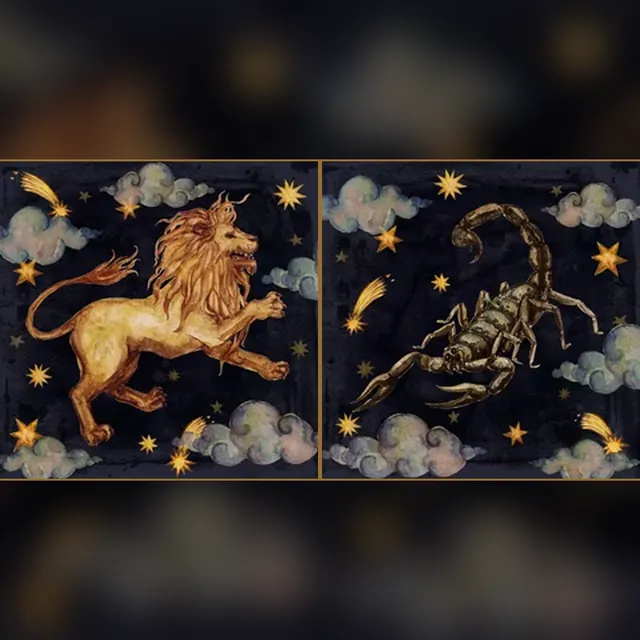
Two fixed signs, and both want to be the most important thing. By the elements rule, Leo is fire and Scorpio is water, and the rule rejects this pair. Keep that in mind and read on, because the rule answers far less than it seems to.
The attraction is strong and usually immediate: both have presence, both take what they feel seriously, and neither is lukewarm. Scorpio recognises in Leo a wholeness he admires, Leo doesn't hide what he wants, and Leo finds in Scorpio the one person who isn't dazzled by the shine and stays anyway. When this pair is loyal, it's loyal in a way that's frightening.
The table every magazine publishes is simple: fire matches fire and air, earth matches earth and water. It was not invented yesterday, and it has a geometric reason, signs of the same element sit 120 degrees apart, and allied elements sit 60 degrees apart. Those are the trine and the sextile, the two aspects that tradition calls harmonious. The compatibility table is the aspect table applied to a single planet.
It puts half the zodiac on each person's list, which already shows how little information that is. And it can be tested against the numbers. I drew a random sample of 600,000 pairs of birth dates between 1966 and 2025, using the same ephemeris that builds charts on this site, and asked: in the pairs the rule approves, do the other pieces follow along?
In the pairs the rule approves, the Moons match in 49.8% of cases; in the ones it rejects, in 50.0%. There is contact between one person's Sun and the other's Moon in 46.4% of both groups, and contact between Venus and Mars in 46.1% and 46.2%. Between the two charts there are, on average, 26.7 contacts in the approved pairs and 26.6 in the rejected ones.
The columns are the same. Knowing that the rule approves or fails your pair tells you nothing about the other person's Moon, nothing about desire, and nothing about how many contacts the two charts have. And 50.0% is exactly what a coin toss would give you.
That does not make the table false. It makes it small: it describes a trait of temperament, read from a single point on the chart. Using it to decide who to date is reading a book by its title's first letter.
They sit at 90 degrees, and both are fixed: it is the hardest standoff in the zodiac. Leo wants love shown in public; Scorpio wants it proven in private. Leo shines outward and Scorpio reads every bit of shine as energy that left home. The fight rises fast and doesn't come back down: neither backs off, one out of pride and the other out of principle, and both know exactly where it hurts to hit.
What decides it is where the rest of the chart softens. A mutable Moon in either one changes the whole pair, because it gives the home someone able to change position without feeling they've lost, and without that, this pair turns every disagreement into proof of love.
What usually unblocks things: agree that what you know about each other stays out of the fight. Both have too much ammunition, and whoever uses it once spends a year rebuilding what they destroyed in ten seconds. And Scorpio gains by asking instead of testing: Leo doesn't respond well to probing, he feels the trap and reacts with a scene, and responds very well to a question asked straight on. And Leo gains by telling Scorpio, at home and with no audience, what he usually says about him in public: it's the only currency Scorpio counts, and the one Leo spends least.
Love Synastry: Couple Compatibility · R$ 197,00
Compare your chart with your partner's: where you match, where you clash and what makes the relationship work.
The element rule reads one thing only: the element. Each sign carries two other labels the table ignores, and in both cases they say more about the day-to-day than the element does. The modality, cardinal, fixed or mutable, is the way a person goes into a subject: cardinal starts it, fixed holds it, mutable changes it. And the ruler is the planet that gives the sign its vocabulary.
Leo is fixed and ruled by the Sun; Scorpio is fixed and ruled by Mars.
Both are fixed in a square, which is the worst combination possible: the modality that doesn't give way at the angle that grates most. This pair doesn't resolve through talking. It resolves through time, through some fact from outside, or through the decision to leave a topic alone forever, and couples of this pair who last usually have an informal list of subjects that are off limits.
The Sun and Mars are the two hottest pieces on the chart, and there's no planet here in charge of cooling things down. One wants recognition, the other wants control; one gives to be seen giving, the other gives to create a bond. These are two kinds of generosity that don't recognise each other as such.
And there's the difference in jealousy, which is the underlying issue. Leo's is about attention: he wants to be the main one in the room. Scorpio's is about exclusivity: he wants to be the only one in the bedroom. Each thinks the other's jealousy is absurd and his own obvious.
There is one exception to "the table tells you nothing", and it comes down to pure geometry. Venus never moves more than 47.2 degrees from the Sun, it is an inner planet, and from Earth's point of view it stays tied to the Sun's light. Given your sun sign, your Venus can only fall in five signs.
So the distance between two sun signs decides the odds that both Venuses land in the same sign. Measured across the same 600,000 pairs:
When both are of the same sign, which is the conjunction, the two Venuses fall in the same sign in 24.3% of pairs; one sign apart, the semi-sextile, in 19.2%; two apart, the sextile, in 12.9%; three apart, the square, in 5.5%; four apart, the trine, in 0.8%; and five or six apart, the quincunx and the opposition, never.
Leo and Scorpio are 90° apart from each other, square, and that puts this pair in the 5.5% bracket. The two of you may well have Venus in the same sign, and it is the one affinity your sun sign guarantees, at least a little.
Notice what the table does with the element rule: it cannot follows the rule. Pairs the rule fails come out on top of the list, and pairs it approves come out at the bottom. The Venus link is real, and it is geometric, and it is why the compatibility table sometimes seems to work. It works a little, and not for the reason it claims to.
Four pieces that change everything, and that no sun-sign table can reach:
- Each person's Moon. It is the way you feel, need and settle down, the piece that most decides day-to-day life together. It changes sign every two and a half days.
- The Ascendant. It changes every two hours and depends on the city. Two Leos born on the same day can arrive at a party in opposite ways.
- The house each one falls into on the other's chart. The same Venus in your house 5 and your house 12 is passion in one case and a private matter in the other. This layer needs both people's birth time.
- What each one has already lived. Age, past relationships and the timing of the meeting weigh more than any aspect, and none of it is in anyone's chart.
This crossing is what's called synastry, and it needs both people's date, time and city of birth. Comparing sun signs is what's left when you don't have that.
And the limit stated out loud still holds: astrology decides nothing for anyone, doesn't tell you to stay or leave, and doesn't replace conversation or therapy. It gives you vocabulary. A couple who discover that one Moon needs routine and the other needs novelty have gained a better question than they had before.
And the questions that come up most on this subject, with the short answer:
Do Leo and Scorpio work? By the elements rule, no: Leo is fire and Scorpio is water. But this rule reads one point on the chart out of ten that exist. I measured 600,000 pairs of birth dates: among the ones the rule approves, the Moons work together 49.8% of the time; among the ones it fails, 50.0%. Chance sits at 50%. Your two sun signs don't tell you whether the relationship works.
What is the aspect between Leo and Scorpio? 90°, which tradition calls a square. That is where the rule of elements comes from, it is the aspect table applied to a single planet. Signs of the same element sit 120 degrees apart, allied elements sit at 60, and the rule rejects the rest.
Can a Leo's Venus be in Scorpio? It can, and it is unlikely: it happens 5.5% of the time. That window is the only thing your sun signs actually decide about each other's charts.
So what decides whether two people are compatible? The crossing of the two full charts, which is what's called synastry: one person's Moon with the other's Sun, one person's Venus with the other's Mars, and the house each one falls into on the other's chart. None of that comes off a sign chart, it needs both people's date, time and city of birth.
Do any two charts have few contacts between them? Quite the opposite: the average is 26.6 contacts between two charts, with a 6-degree orb, and across 600,000 randomly drawn pairs none came out at zero. That's why "we have so many aspects!" means nothing on its own. What a reading does with the 26.6 is weigh them, not add them up.
In short, this pair reads like this:
Keywords two fixed signs, jealousy, the ammunition left unused
The numbers on this page hold for any pair of people, because they come from the sky. What does not show up in them is your case. Two charts bring 26.6 contacts on average, and what a reading does with them is weigh, which are exact, which involve the Moon, which fall in a house that matters. Without both birth dates, times and cities, this page describes two signs, not two people.