The short answer
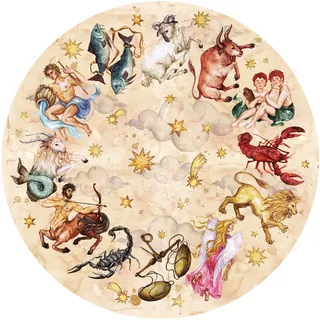
Two who talk a lot and decide little. By the element rule, Gemini is air and Gemini is air — and the rule approves this pair. Keep that in mind and read on, because the rule answers far less than it seems to.
Two Geminis never run out of things to say, and that is no small thing: most people tire of a Gemini within three months, and here neither one tires. Both change their minds without accusing the other of being inconsistent, both find the same silly things funny, and neither demands that a conversation end in a conclusion. The house is light and the humour is quick.
What the element rule says, and what I measured
The table every magazine publishes is simple: fire matches fire and air, earth matches earth and water. It was not invented yesterday, and it has a geometric reason — signs of the same element sit 120 degrees apart, and allied elements sit 60 degrees apart. Those are the trine and the sextile, the two aspects that tradition calls harmonious. The compatibility table is the aspect table applied to a single planet.
It puts half the zodiac on each person's list, which already shows how little information that is. And it can be tested against the numbers. I drew a random sample of 600,000 pairs of birth dates between 1966 and 2025, using the same ephemeris that builds charts on this site, and asked: in the pairs the rule approves, do the other pieces follow along?
| Between any two charts | Pairs the rule approves | Pairs it fails |
|---|---|---|
| The Moons match up | 49.8% | 50.0% |
| There's a Sun–Moon contact | 46.4% | 46.4% |
| There's a Venus–Mars contact | 46.1% | 46.2% |
| Contacts between the two charts | 26.7 | 26.6 |
The columns are the same. Knowing that the rule approves or fails your pair tells you nothing about the other person's Moon, nothing about desire, and nothing about how many contacts the two charts have. And 50.0% is exactly what a coin toss would give you.
That does not make the table false. It makes it small: it describes a trait of temperament, read from a single point on the chart. Using it to decide who to date is reading a book by its title's first letter.
Gemini and Gemini in practice: where this pair gets stuck
The blind spot is the decision. Gemini argues well and decides badly; two Geminis argue even better and never decide at all. The bill goes unpaid, the move to a new place gets pushed to next year, the serious matter turns into a joke before it is finished. And there is a specific way of fighting: both are good with words, so the argument turns into sport, and whoever wins it has not solved anything — only made the other one go quiet.
What decides it is where the rest of the chart DIFFERS. Two Geminis with Moon in Capricorn and Moon in Aquarius are not the same house: one needs structure to sleep soundly, the other needs space and does not know how to ask for it.
What usually unblocks things: set a deadline on something small. Not a life plan — the date the shelf gets put together, the day the money conversation happens. Two mutable signs keep an agreed deadline and do not keep an intention. And a fighting rule is worth having: when the subject turns into a joke, someone says “this is serious” out loud. It sounds small, and it is the only thing that stops the complaint from disappearing into humour for the third time. And it helps to decide who decides what, by area, once and for all: with no one in charge, the decision sits on the table until someone loses patience — and then it comes out wrong and angry.
Your Moon changes sign every two and a half days, and your Ascendant every two hours. It is the difference between “we are Gemini and Gemini” and knowing what the two of you actually are.
Generate my chart for freeWhat the element table doesn't look at in this pair
The element rule reads one thing only: the element. Each sign carries two other labels the table ignores, and in both cases they say more about the day-to-day than the element does. The modality — cardinal, fixed or mutable — is the way a person goes into a subject: cardinal starts it, fixed holds it, mutable changes it. And the ruler is the planet that gives the sign its vocabulary.
Gemini is mutable and ruled by Mercury; Gemini is mutable and ruled by Mercury.
Both are mutable, and it is the combination with the least friction and the least direction in the zodiac. Mutable adapts, and two who adapt end up adjusting to each other without either saying where they are going. This works very well when life is good and falls apart quickly in a crisis, because in a crisis someone needs to say “this way” — and that is exactly what neither one does.
And both belong to Mercury, the planet that knows and does not want. Mercury gathers information, compares, explains — and has no will of its own: Mars is the one that wants, the Sun is the one that decides. A house run by two Mercurys is very well informed about the options it never chose.
Notice what this does to this pair's fights. Since neither one has a fixed position, disagreement does not turn into a trench; it turns into irony. And irony does not get resolved, because it was never spoken as a complaint — which leaves this pair with a collection of subjects that are always nearby and never on the table.
The one thing your sun sign decides about the other person
There is one exception to "the table tells you nothing", and it comes down to pure geometry. Venus never moves more than 47.2 degrees from the Sun — it is an inner planet, and from Earth's point of view it stays tied to the Sun's light. Given your sun sign, your Venus can only fall in five signs.
So the distance between two sun signs decides the odds that both Venuses land in the same sign. Measured across the same 600,000 pairs:
| Signs apart | Aspect | Both Venuses in the same sign |
|---|---|---|
| 0 (the same sign) | conjunction | 24.3% |
| 1 sign | semi-sextile | 19.2% |
| 2 signs | sextile | 12.9% |
| 3 signs | square | 5.5% |
| 4 signs | trine | 0.8% |
| 5 or 6 signs | quincunx and opposition | 0.0% |
Gemini and Gemini are 0° apart — conjunction — and that puts this pair in the 24.3% bracket. The two of you may well have Venus in the same sign, and it is the one affinity your sun sign guarantees, at least a little.
Notice what the table does with the element rule: it cannot follows the rule. Pairs the rule fails come out on top of the list, and pairs it approves come out at the bottom. The Venus link is real, and it is geometric — and it is why the compatibility table sometimes seems to work. It works a little, and not for the reason it claims to.
What no sign table can reach
Four pieces that change everything, and that no sun-sign table can reach:
- Each person's Moon. It is the way you feel, need and settle down — the piece that most decides day-to-day life together. It changes sign every two and a half days.
- The Ascendant. It changes every two hours and depends on the city. Two Geminis born on the same day can arrive at a party in opposite ways.
- The house each one falls into on the other's chart. The same Venus in your house 5 and your house 12 is passion in one case and a private matter in the other. This layer needs both people's birth time.
- What each one has already lived. Age, past relationships and the timing of the meeting weigh more than any aspect — and none of it is in anyone's chart.
This crossing is what's called synastry, and it needs both people's date, time and city of birth. Comparing sun signs is what's left when you don't have that.
And the limit stated out loud still holds: astrology decides nothing for anyone, doesn't tell you to stay or leave, and doesn't replace conversation or therapy. It gives you vocabulary. A couple who discover that one Moon needs routine and the other needs novelty have gained a better question than they had before.
Frequently asked questions about Gemini and Gemini
Do Gemini and Gemini match?
By the element rule, yes: Gemini is air and Gemini is air. But that rule reads one point in the chart out of the ten that exist. I measured 600,000 pairs of birth dates: among the ones the rule approves, the Moons match 49.8% of the time; among the ones it rejects, 50.0%. The rate of chance is 50%. Your sun signs do not tell you whether the relationship works.
What is the aspect between Gemini and Gemini?
0°, which tradition calls a conjunction. It is zero distance: the same sign, with everything that repeats because of it.
Can a Gemini's Venus be in Gemini?
It can, and it is the most common case: 24.3% of the time both Venuses fall in the same sign. That window is the only thing your sun signs actually decide about each other's charts.
So what decides whether two people are compatible?
The crossing of the two full charts, which is what's called synastry: one person's Moon with the other's Sun, one person's Venus with the other's Mars, and the house each one falls into on the other's chart. None of that comes off a sign chart — it needs both people's date, time and city of birth.
Do any two charts have few contacts between them?
Quite the opposite: the average is 26.6 contacts between two charts, with a 6-degree orb, and across 600,000 randomly drawn pairs none came out at zero. That's why "we have so many aspects!" means nothing on its own. What a reading does with the 26.6 is weigh them, not add them up.
Gemini and Gemini in summary
Keywords conversation, the missing decision, two Mercurys
The numbers on this page hold for any pair of people, because they come from the sky. What does not show up in them is your case. Two charts bring 26.6 contacts on average, and what a reading does with them is weigh — which are exact, which involve the Moon, which fall in a house that matters. Without both birth dates, times and cities, this page describes two signs, not two people.
